


ILEANA MULET
THE HOURGLASS
A Tribute to Jorge Luis Borges
ARTIST'S PERSPECTIVE
THE STORY BEHIND THE WORK
The Hourglass emerges from Ileana Mulet’s encounter with Jorge Luis Borges’s poem of the same name, in which time becomes an essential presence.
Mulet recognizes in Borges’s poem a profound connection with her own visual universe and, particularly, with the phenomenon of landscape. Time, waiting, water, sunlight, the falling of evening, and the presence of instruments become points of encounter between poetry and painting.
Rather than illustrating Borges’s poem, Mulet finds within it a sensibility that already inhabits her work: a landscape suspended between light and shadow, movement and stillness, the passage of time and the persistence of waiting.
In this encounter, the landscape becomes more than a physical place. It becomes a territory through which time can be experienced.

01 — TIME
THE PASSAGE OF TIME
Time lies at the center of the encounter between Borges’s poem and Mulet’s painting.
In The Hourglass, time is not presented simply as something measured. It is experienced through change: through water, light, the falling of evening, and the transformation of the landscape.
The landscape becomes a place where one moment gives way to another. Nothing appears entirely fixed; forms, atmosphere, and light seem to exist within a continuous process of transition.
Like the sand within an hourglass, time is perceived through its passage.

02 — THE LANDSCAPE
A TERRITORY OF TIME
Landscape occupies a central place in Mulet’s visual language and becomes one of the strongest points of connection between her work and Borges’s poem.
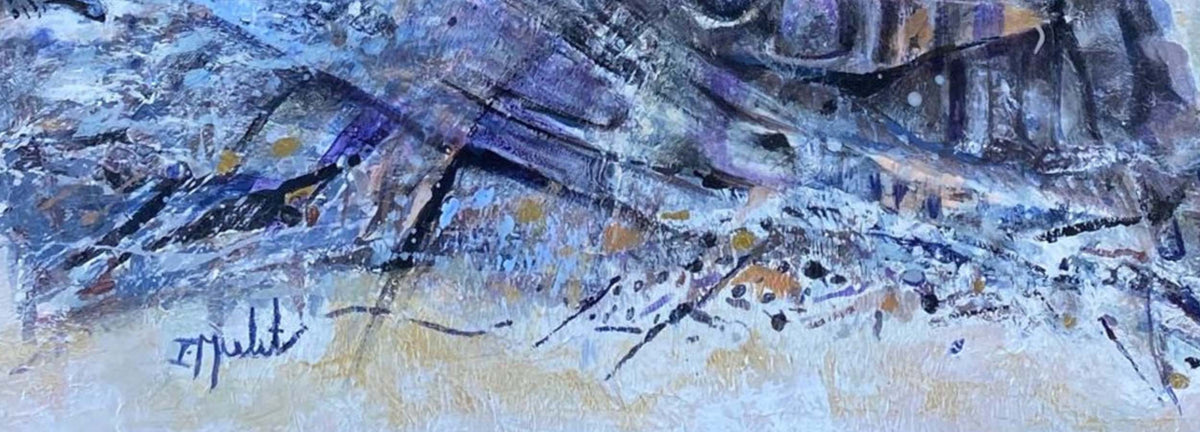
In The Hourglass, the landscape is not merely a setting. Water, architectural forms, structures, and traces of human presence coexist within an atmosphere that seems to be continually changing.
Light passes through the composition while forms emerge, dissolve, and overlap, suggesting a landscape experienced through time rather than observed at a single, fixed moment.
Here, landscape becomes a space where time leaves its traces.
03 — WAITING
BETWEEN DAY AND NIGHT
For Mulet, one of the most compelling ideas in Borges’s poem is the presence of waiting.
Evening falls, light changes, and yet something remains unresolved. Time continues to pass, but the landscape seems suspended between what has already occurred and what is still to come.
This sense of waiting transforms the passage of time into an experience of anticipation. The landscape does not simply record the falling of evening; it appears to inhabit the interval between one moment and the next.
BORGES × MULET
TIME AS LANDSCAPE
In Borges’s The Hourglass, time is evoked through images of water, sunlight, evening, and the instruments through which human beings attempt to measure its passage.
Mulet encounters these ideas through the language of landscape. Rather than translating the poem literally into painting, she allows time to emerge through atmosphere, changing light, water, structures, and the sensation of waiting.
What Borges explores through poetry becomes, in Mulet’s work, a visual experience: a landscape in transition, suspended between light and shadow, presence and disappearance, one moment and the next.
The result is not an illustration of the poem, but a meeting between two languages in which time becomes both subject and landscape.
BORGES × MULET
TWO LANGUAGES IN DIALOGUE
Borges explores time through language; Mulet transforms its passage into landscape. Between them emerges a shared meditation on waiting, light, shadow, and the continuous transformation of experience.
BORGES'S LITERARY UNIVERSE
TIME
WATER
SUNLIGHT
EVENING
WAITING
MULET'S VISUAL INTERPRETATION
LANDSCAPE
ATMOSPHERE
LIGHT AND SHADOW
TRANSITION
SUSPENSION
ARTIST'S VOICE
ILEANA MULET
Reflecting on The Hourglass and her encounter with Jorge Luis Borges’s poem, Ileana Mulet explains:
“Night falls, but beyond that, there is still a sense of waiting. That is what I found most compelling in the poem.”
— Ileana Mulet

IN THE ARTIST’S WORDS

BE PART OF THE ART
Discover new artworks, exhibitions, artist stories and special releases from Roselle Gallery.