

FRIDA, A CARIBBEAN DREAM
WHERE OUR STORY BEGAN · 2022–2026
MEXICO CITY · OCTOBER 27, 2022
Where Our Story Began
On October 27, 2022, in the heart of Mexico City, Roselle Gallery began its journey with Frida, a Caribbean Dream, an exhibition by Cuban artist Esteban Machado Díaz at Casa León.
More than an inaugural exhibition, it marked the beginning of a cultural vision: to celebrate contemporary Latin American art, honor our shared heritage, and build meaningful connections between artists, institutions, collectors, and audiences across borders.
Four years later, we return to where our story began, celebrating twelve works of art and the enduring dialogue between Frida Kahlo's legacy, Caribbean identity, and the poetic universe of José Martí.
ESTEBAN MACHADO DÍAZ · FRIDA, A CARIBBEAN DREAM
The Artist's Vision
Frida, a Caribbean Dream is an opportunity to pay tribute to the history of our peoples and our roots. It is an encounter with our past, enriched by the traces left not only by Frida herself, but also by all those who shaped a path that continues to enrich our souls and spirits.
From José Martí and his great friend Manuel Mercado, who forged the bonds that unite our cultures, to the present day, Frida Kahlo's figure, viewed through our Martían perspective, is characterized by a philosophical language in which landscape and the human figure become the principal means of expression.
We deliberately draw upon Martí's prose through a system of recurring symbols: the monarch butterfly, particularly significant in this tribute, whose migration represents perseverance, faith, and the pursuit of a dream; the Caribbean landscape; the sky; waterfalls; and the hummingbird. Together, these elements reveal the strong historical and cultural ties that unite us.
We narrate experiences, heartbreak, dreams, encounters, and separations through the study, influence, and fusion of Mexican culture with Caribbean roots. Each work is an invitation to engage in dialogue with history and the spiritual legacy that creates a sense of connection between the viewer and the exhibition.
It is an evocation of love, history, and cultural continuity.
Esteban Machado Díaz
Artist's Statement — Frida, a Caribbean Dream
ESTEBAN MACHADO DÍAZ · FRIDA, A CARIBBEAN DREAM
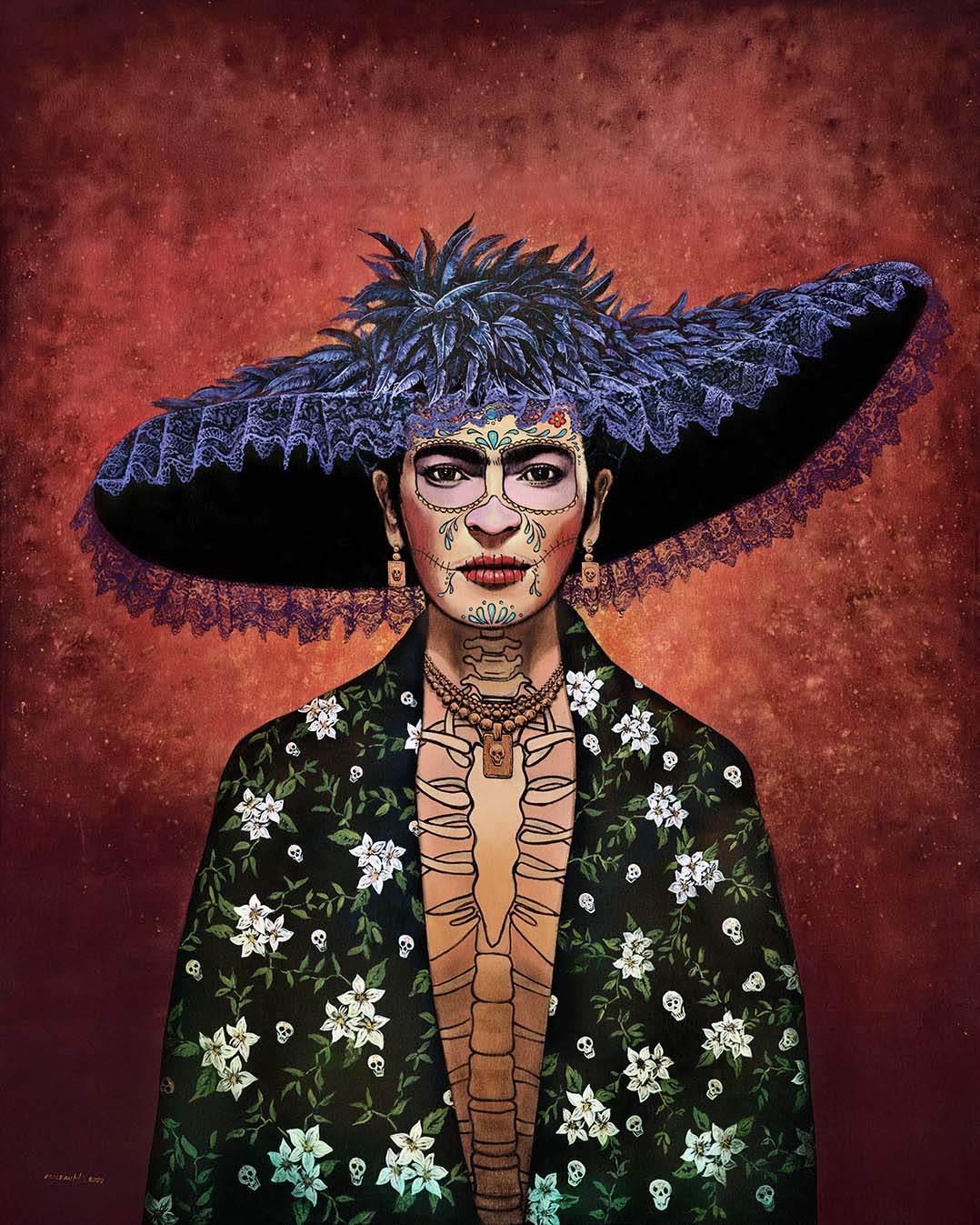
La Catrina
In La Catrina, Cuban artist Esteban Machado Díaz reimagines Frida Kahlo through the symbolism of Mexico's Day of the Dead, bringing together beauty, memory, and spiritual transcendence.
Frida appears adorned with ceremonial makeup and an elaborate hat that evokes the iconic figure of La Catrina in Diego Rivera's mural Dream of a Sunday Afternoon in the Alameda Central.
Beyond its visual references, the painting explores a deeper dimension of Frida's identity. Her decorated face becomes an expression of inner beauty, emotional depth, and spiritual growth, transforming a traditional symbol of mortality into a celebration of the human spirit.
Through this interpretation, Machado Díaz establishes a dialogue between Mexican cultural heritage and his own artistic vision, honoring Frida as a figure whose legacy continues to transcend time.
Curatorial interpretation — Roselle Gallery
ESTEBAN MACHADO DÍAZ · FRIDA, A CARIBBEAN DREAM
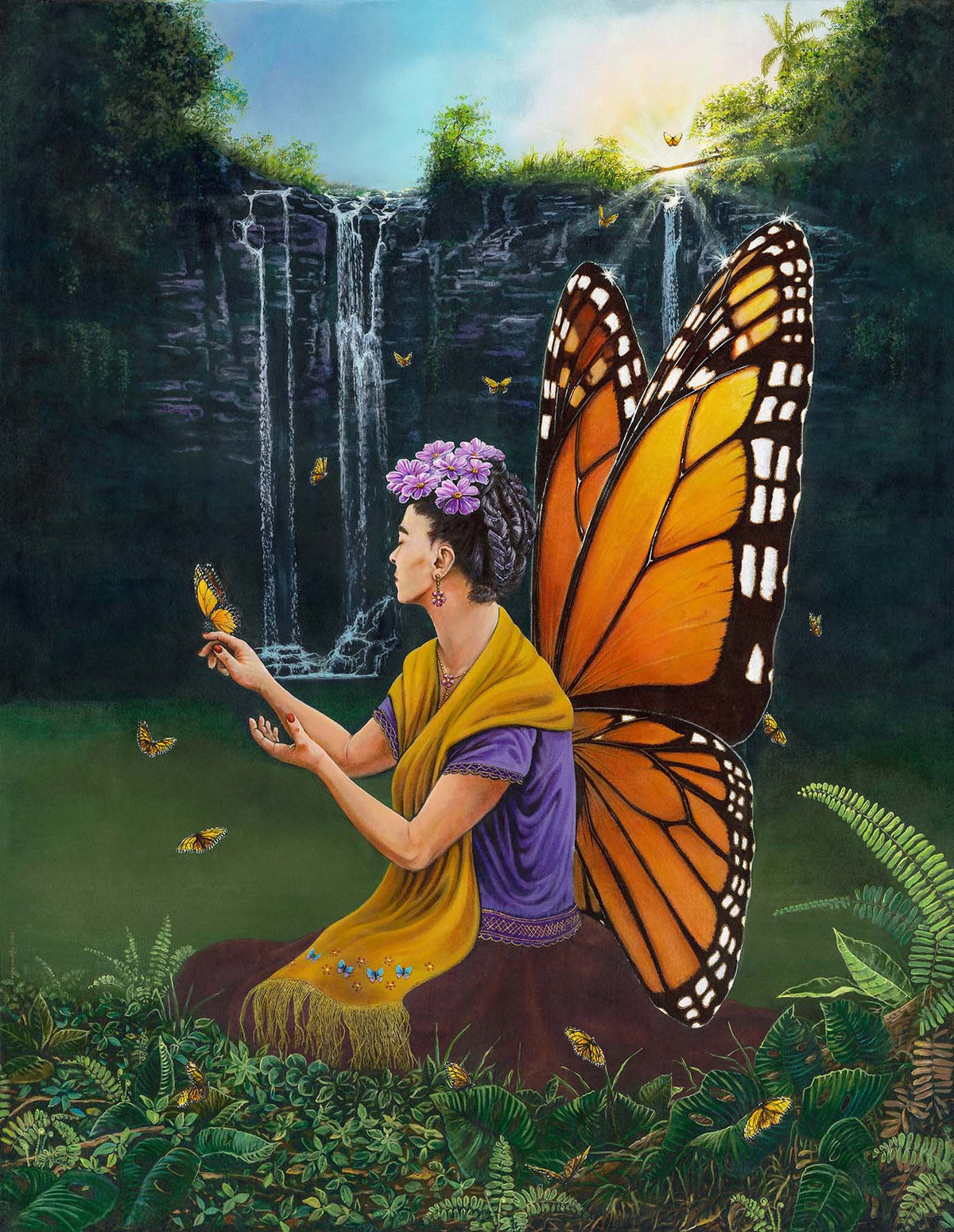
FRIDA, LA MONARCA
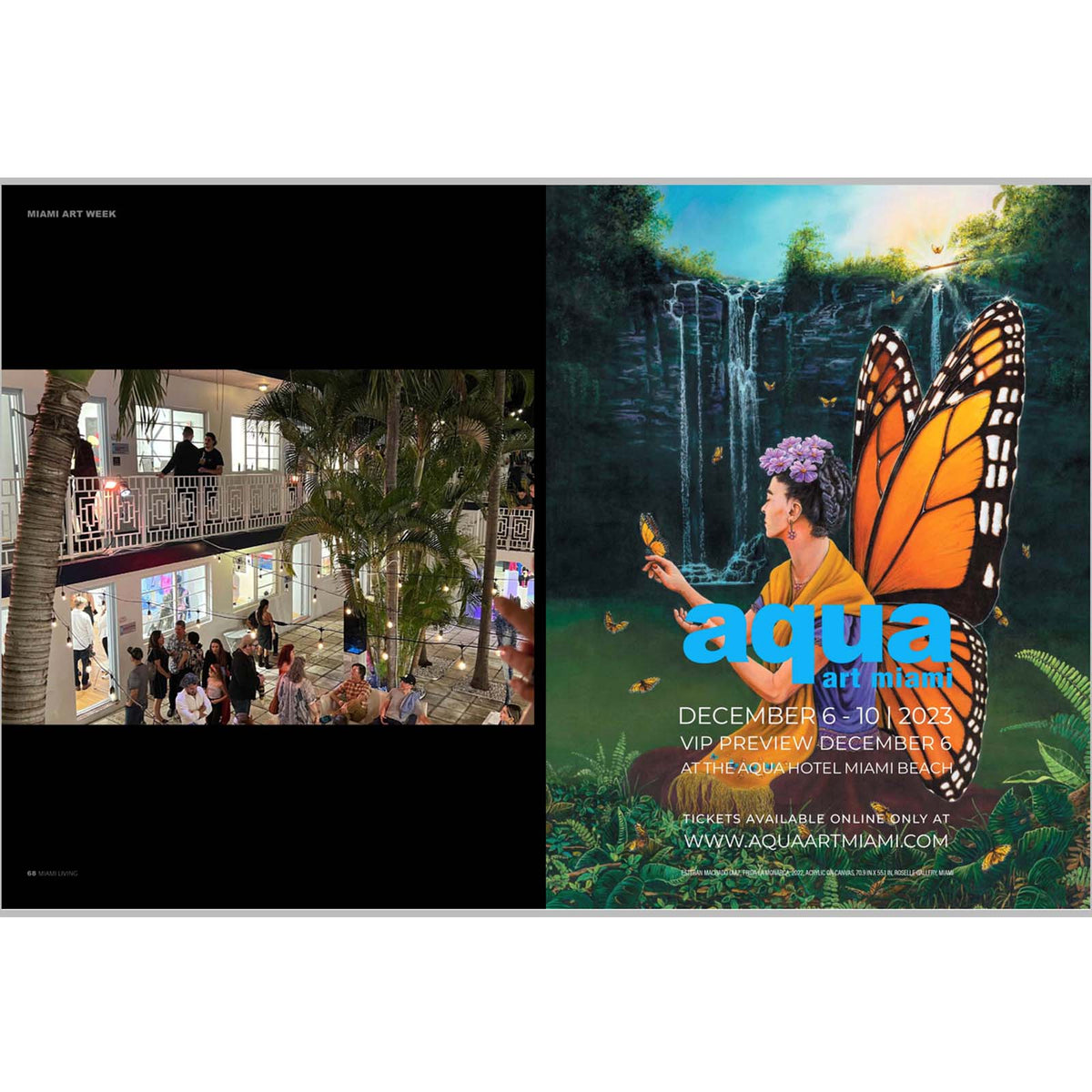
In Frida, la Monarca, Cuban artist Esteban Machado Díaz brings together the figure of Frida Kahlo and the monarch butterfly, creating a poetic vision of transformation, resilience, and spiritual freedom.
Inspired by the poetry of José Martí, the painting presents Frida with butterfly wings, surrounded by Caribbean vegetation and the symbolic presence of nature. The composition establishes a dialogue between Mexican cultural heritage and the artist's Caribbean roots.
The monarch butterfly holds particular significance in this tribute. Its annual migration to Mexico coincides with the season of the Day of the Dead, connecting the natural world with remembrance, ancestral traditions, and the continuity of life.
Frida's transformation into a winged figure also evokes her celebrated words: “Feet, what do I need you for when I have wings to fly?” Through this image, Machado Díaz honors her capacity to transcend suffering through imagination and artistic creation.
Curatorial interpretation — Roselle Gallery
ESTEBAN MACHADO DÍAZ · FRIDA, A CARIBBEAN DREAM
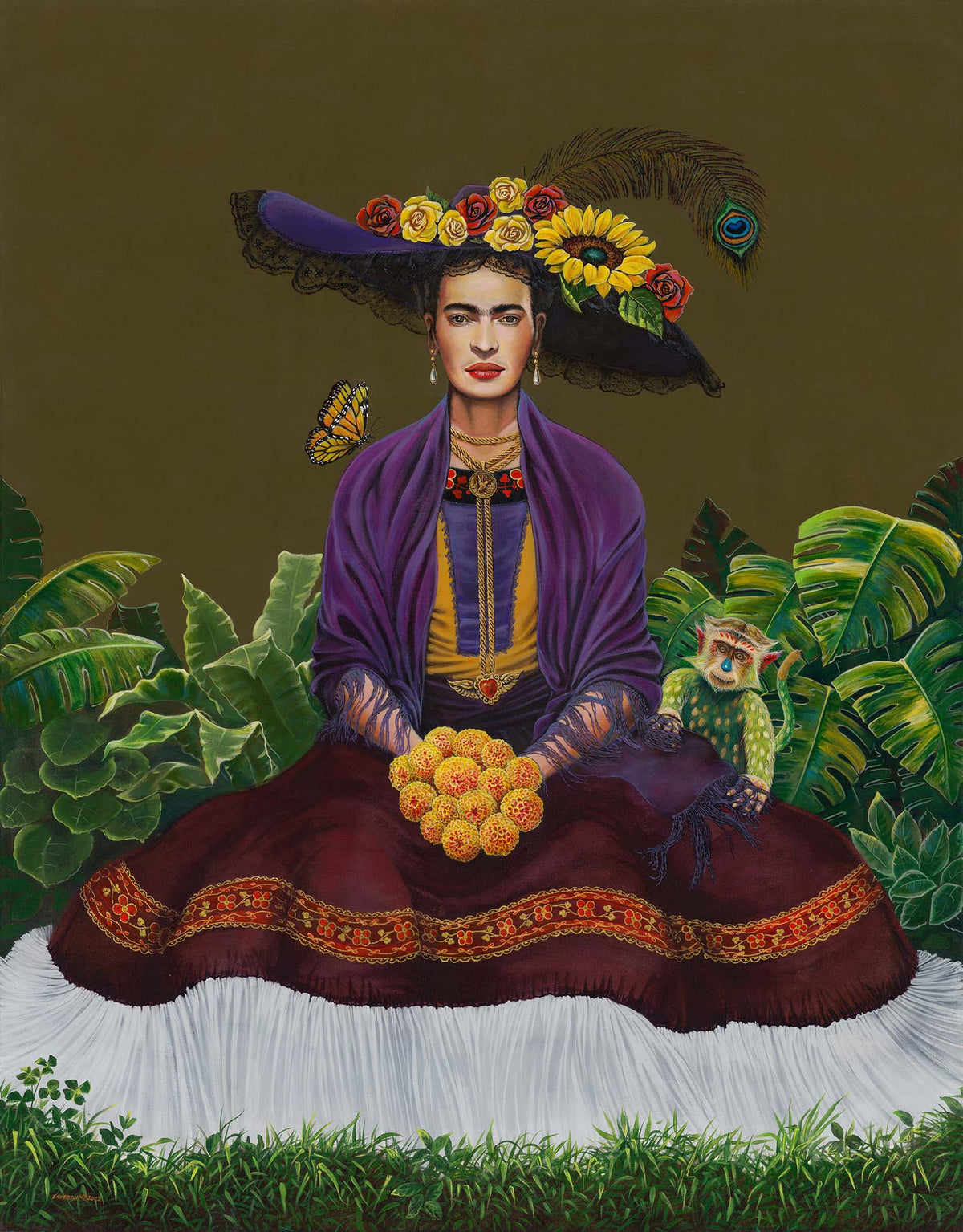
FLOR SOLITARIA
In Flor solitaria, Cuban artist Esteban Machado Díaz explores a deeply human dimension of Frida Kahlo: the experience of solitude and its relationship with suffering, inner growth, and spiritual transcendence.
Although surrounded by friends and loved ones, Frida also experienced loneliness. Machado Díaz approaches this emotional reality not simply as a source of pain, but as an experience through which the human spirit can discover new dimensions of strength and self-awareness.
Emerging symbolically from the underworld, Frida appears as a mystical and magical presence. The painting celebrates not only her extraordinary artistic legacy but also the depth and greatness of her humanity.
Through this interpretation, Flor solitaria invites viewers to contemplate solitude as a space of transformation, where vulnerability, memory, and spiritual resilience become part of a larger reflection on human existence.
Curatorial interpretation — Roselle Gallery
ESTEBAN MACHADO DÍAZ · FRIDA, A CARIBBEAN DREAM
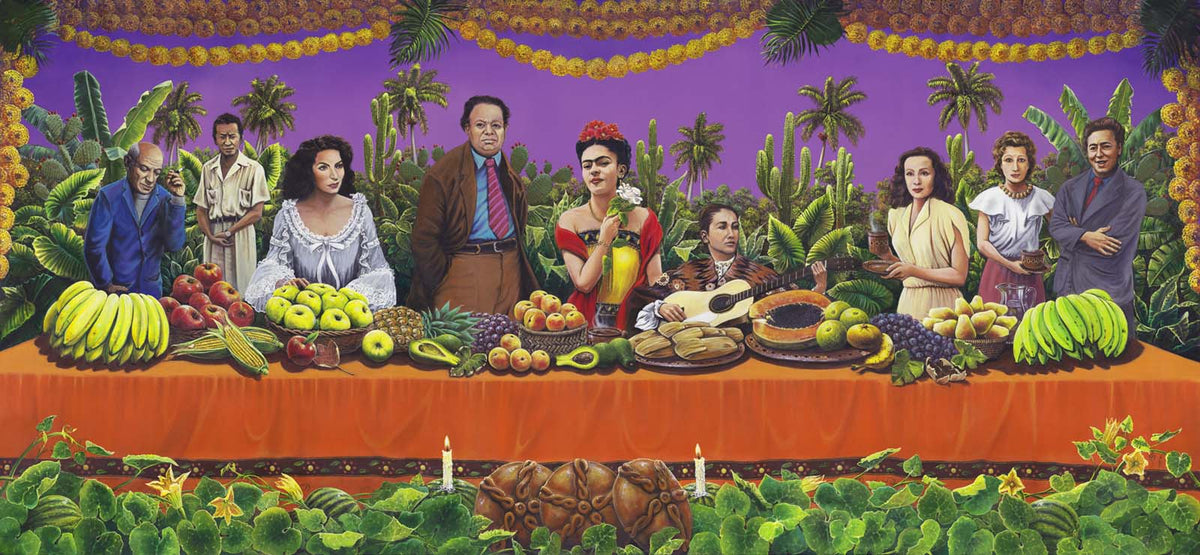
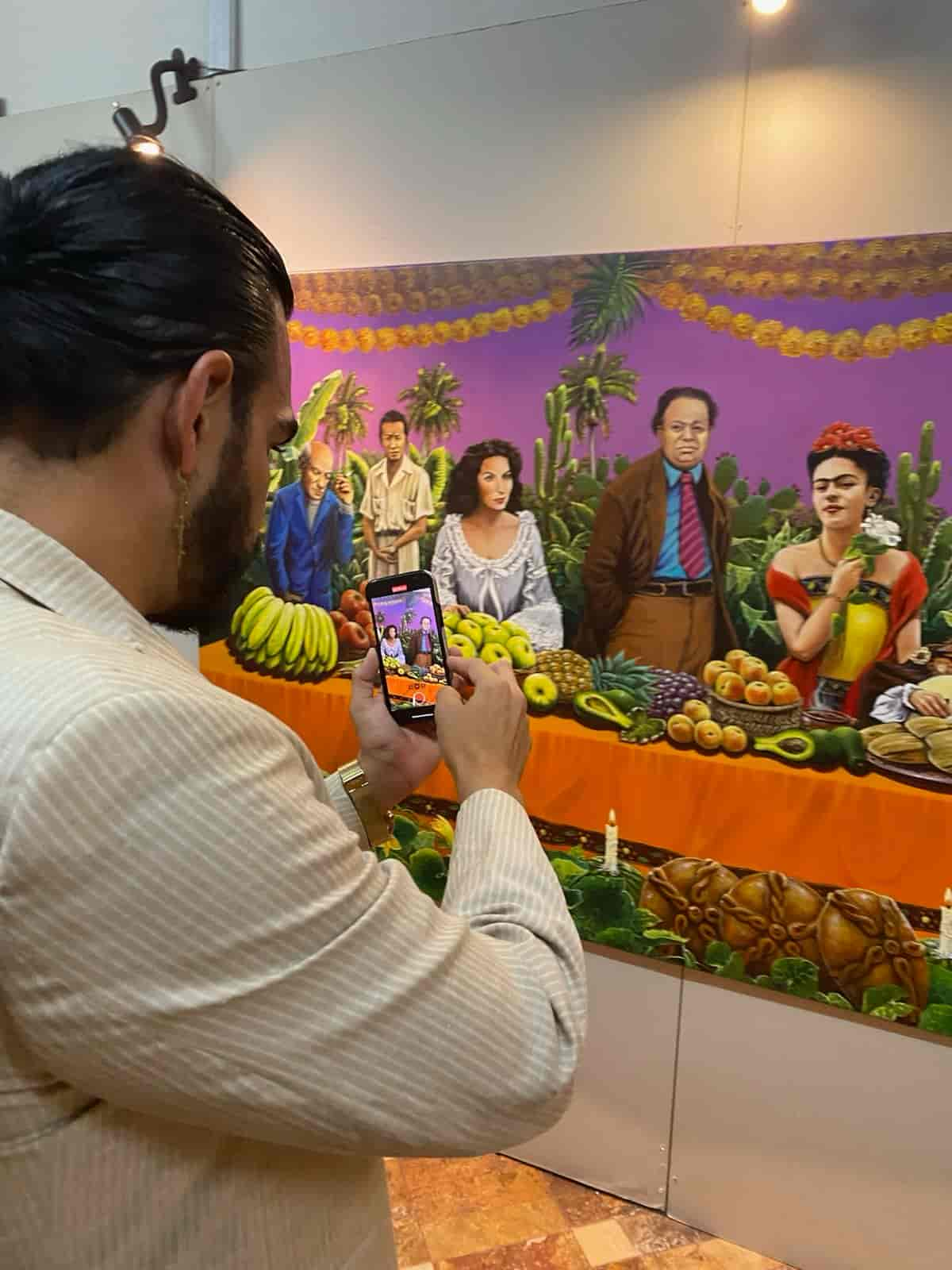
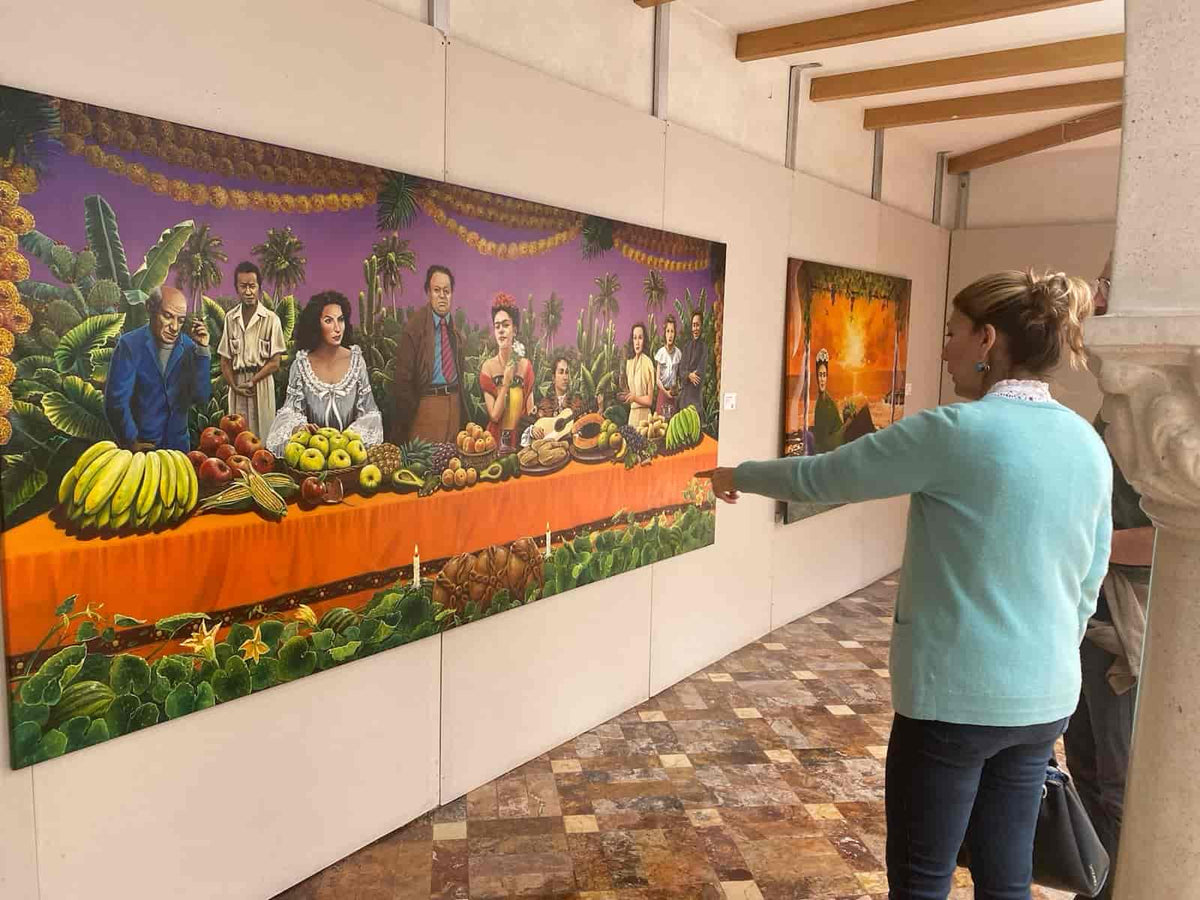
CENA ENTRE AMIGOS
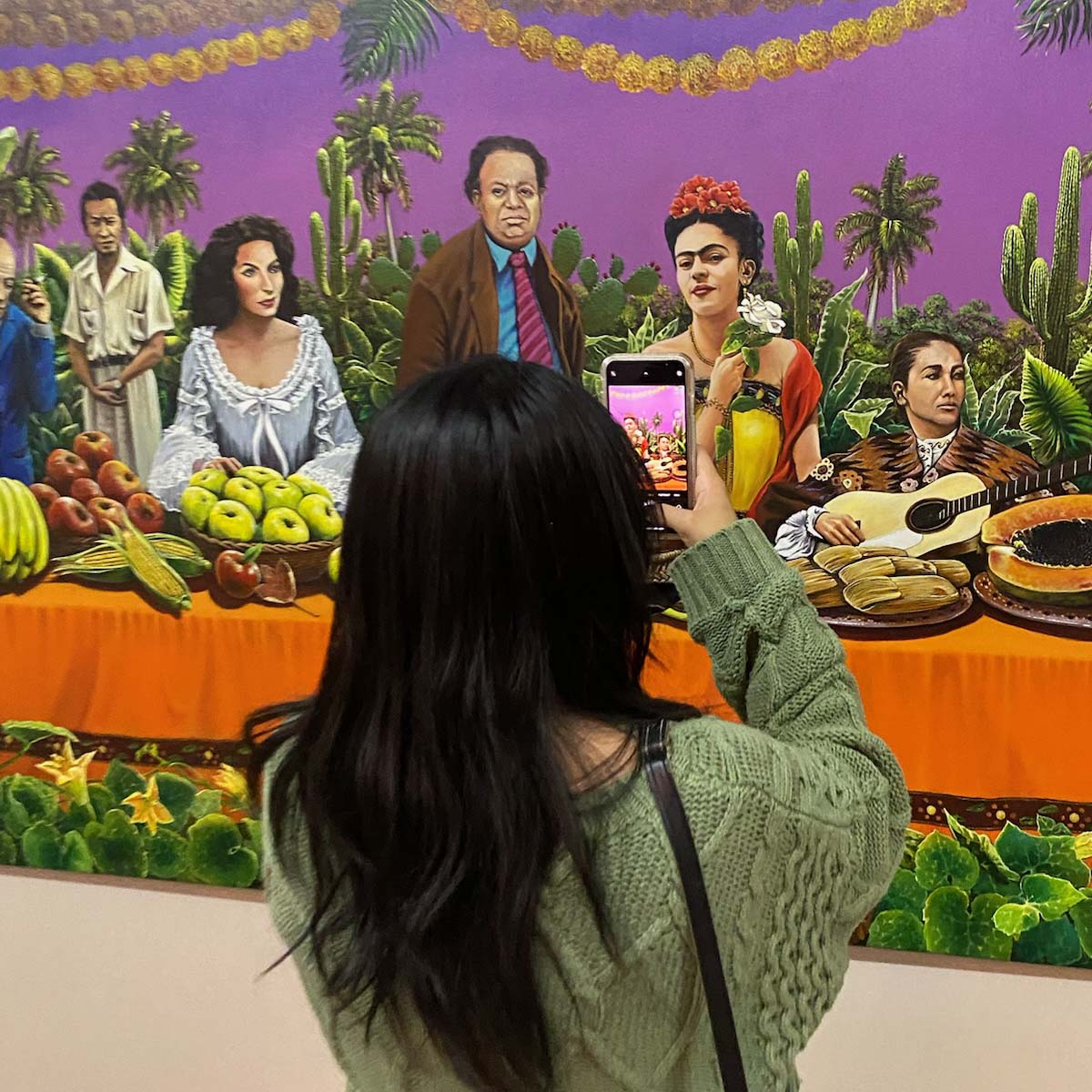
In Cena entre amigos, Cuban artist Esteban Machado Díaz brings together Frida Kahlo and an extraordinary gathering of artists and cultural figures in a celebration of friendship, memory, and the enduring power of human connection.
Inspired by the traditions of the Day of the Dead, the painting presents a symbolic table adorned with flowers, fruits, and traditional foods. Around it, Frida is joined by Diego Rivera, María Félix, Chavela Vargas, Dolores del Río, Pablo Picasso, Wifredo Lam, André Breton, and Jacqueline Lamba.
This imagined encounter transcends geography and time. Mexican and Cuban cultural traditions converge in a scene where artistic affinities, shared histories, and personal relationships become part of a collective celebration of life.
Rather than portraying a historical gathering, Machado Díaz creates a poetic reunion in which remembrance becomes an expression of affection. Through this vibrant composition, the artist invites us to reflect on the bonds that connect individuals across generations and on the ways art preserves their presence in our collective memory.
Curatorial interpretation — Roselle Gallery
ESTEBAN MACHADO DÍAZ · FRIDA, A CARIBBEAN DREAM
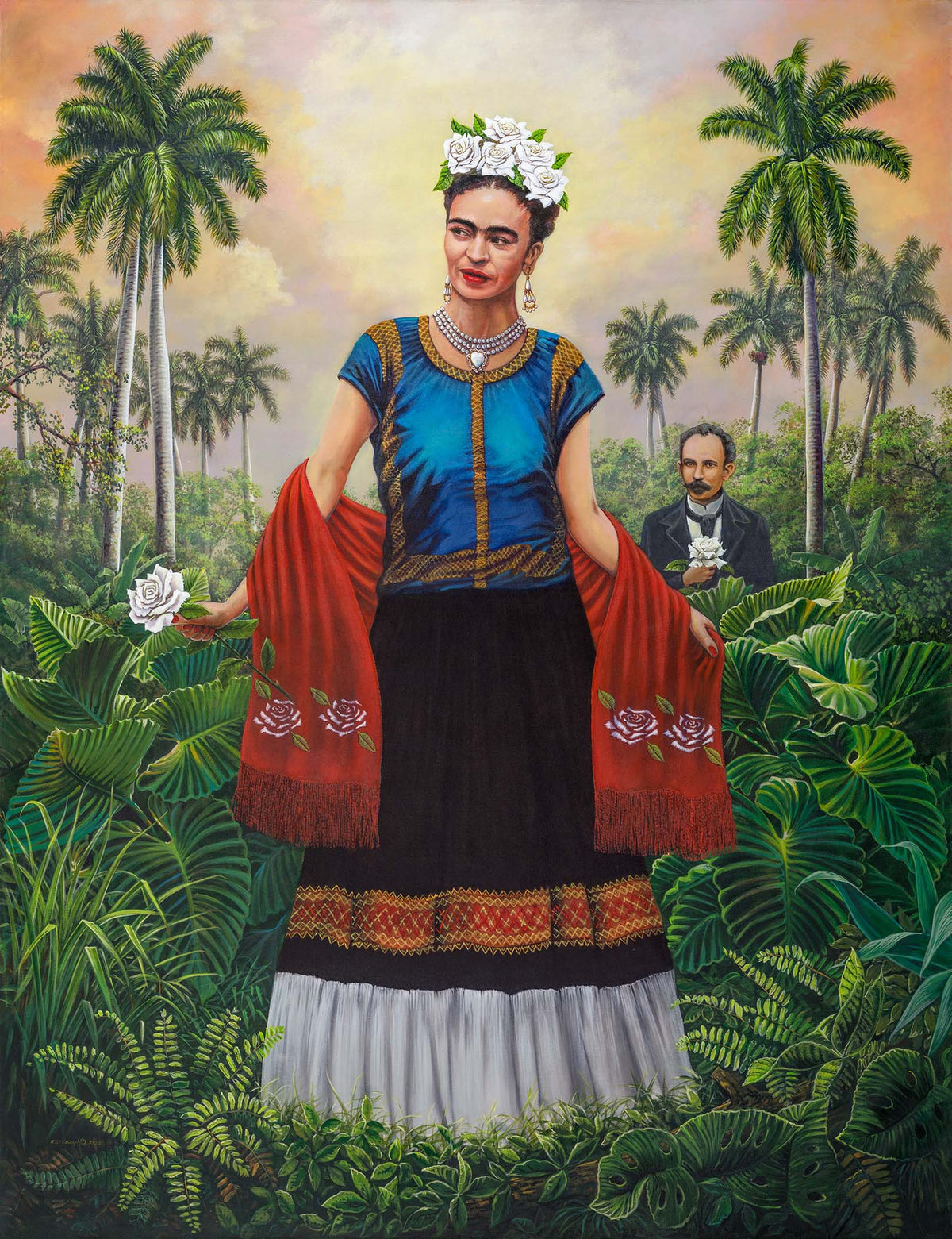
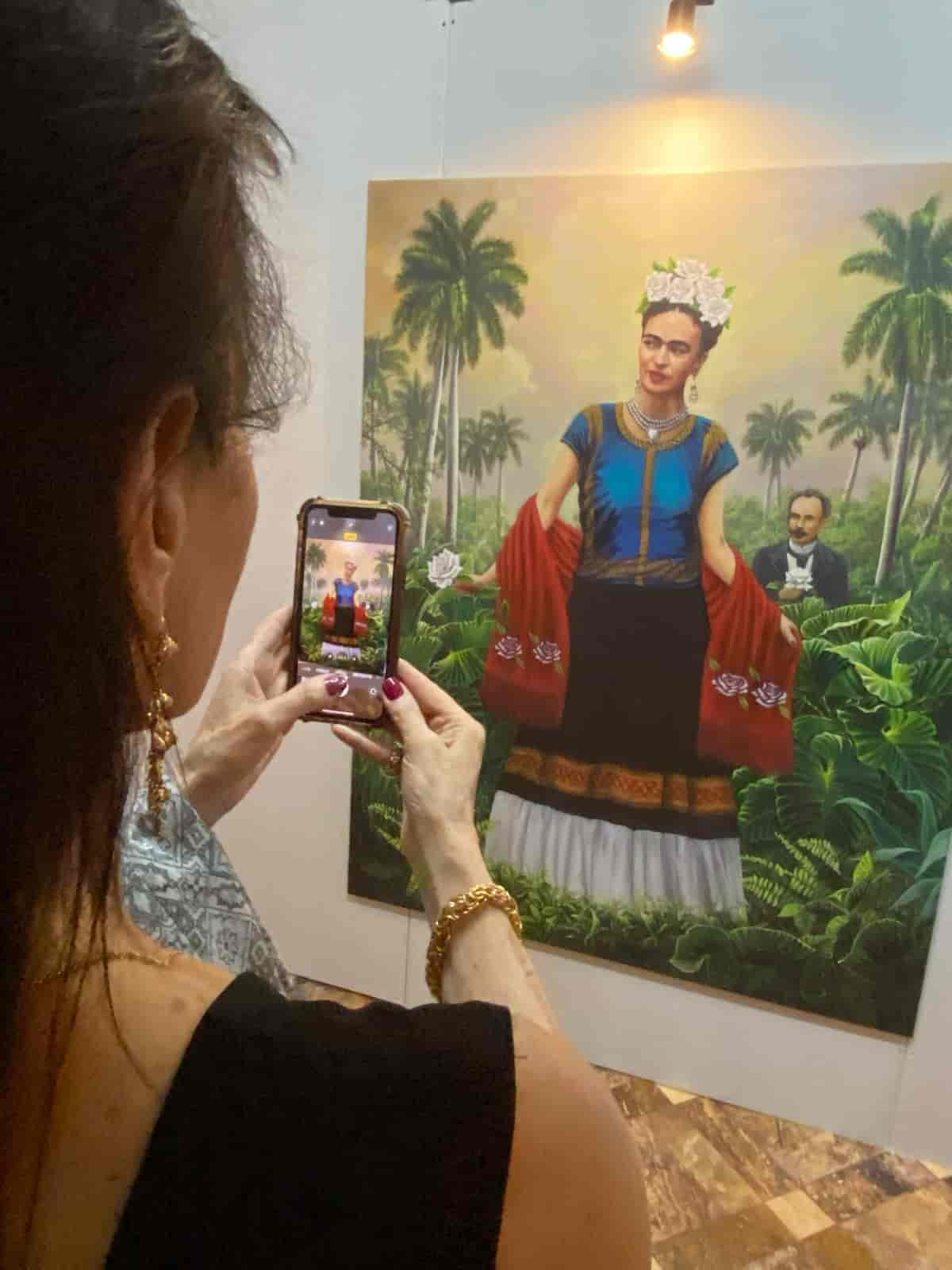
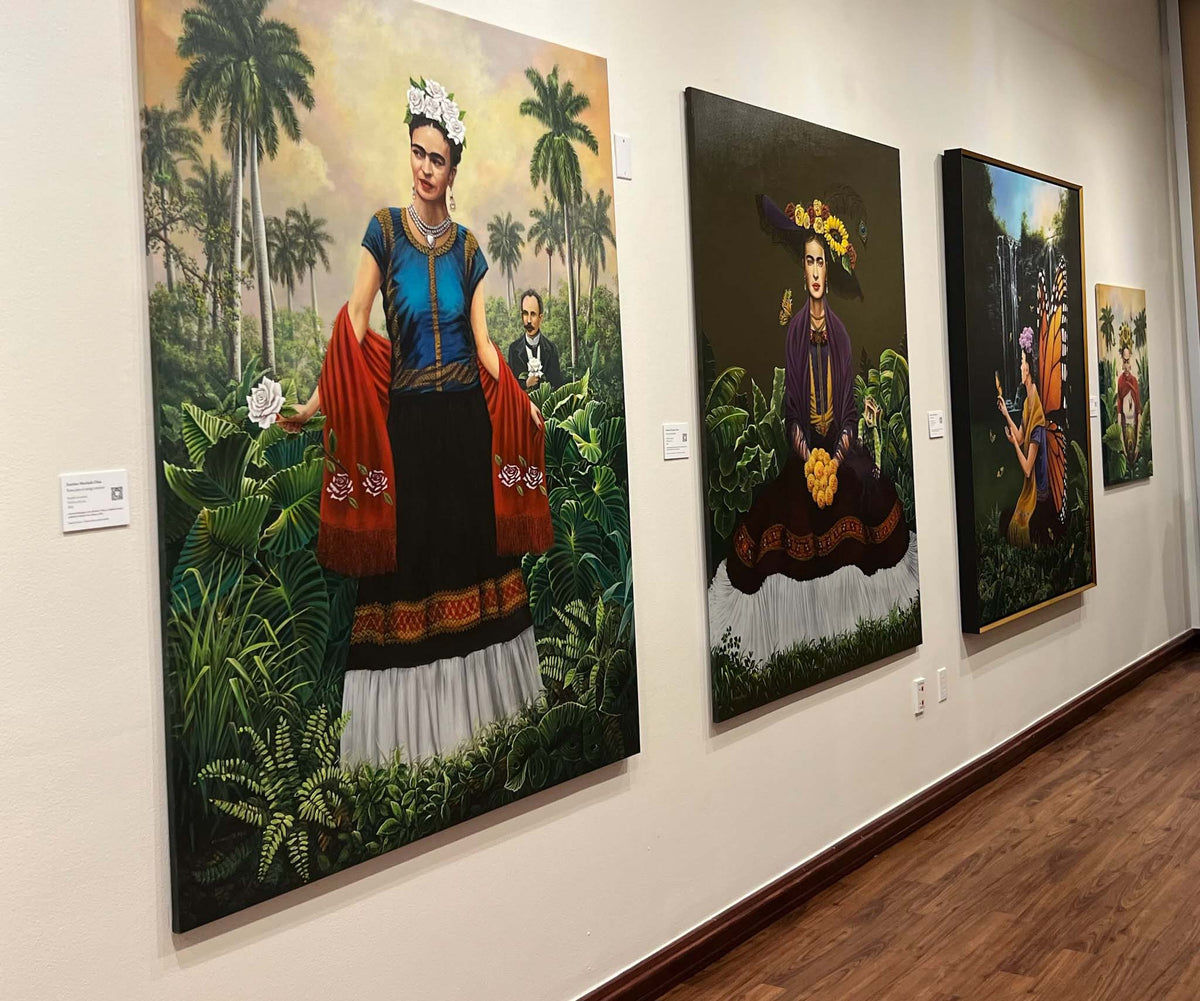
ROSA PARA EL AMIGO SINCERO
In Rosa para el amigo sincero, Cuban artist Esteban Machado Díaz brings together the spirit of Frida Kahlo and the poetic legacy of José Martí in a reflection on friendship, sincerity, and the enduring beauty of human connection.
Frida appears holding a white rose amid a verdant landscape, while the spiritual presence of José Martí evokes the celebrated verses of his poem Cultivo una rosa blanca. The flower becomes a symbol of generosity, affection, and the capacity of friendship to transcend cultural and geographical boundaries.
Through this symbolic encounter, Machado Díaz establishes a dialogue between two extraordinary figures whose lives and legacies remain deeply connected to the cultural identities of Mexico and Cuba.
The painting also recalls Frida Kahlo's intimate relationship with flowers and nature, transforming the white rose into an expression of remembrance, hope, and spiritual continuity.
More than a tribute to two historical figures, Rosa para el amigo sincero celebrates the universal values that bring people together across generations, reminding us that sincere friendship, like art, can endure beyond the passage of time.
Curatorial interpretation — Roselle Gallery
ESTEBAN MACHADO DÍAZ · FRIDA, A CARIBBEAN DREAM
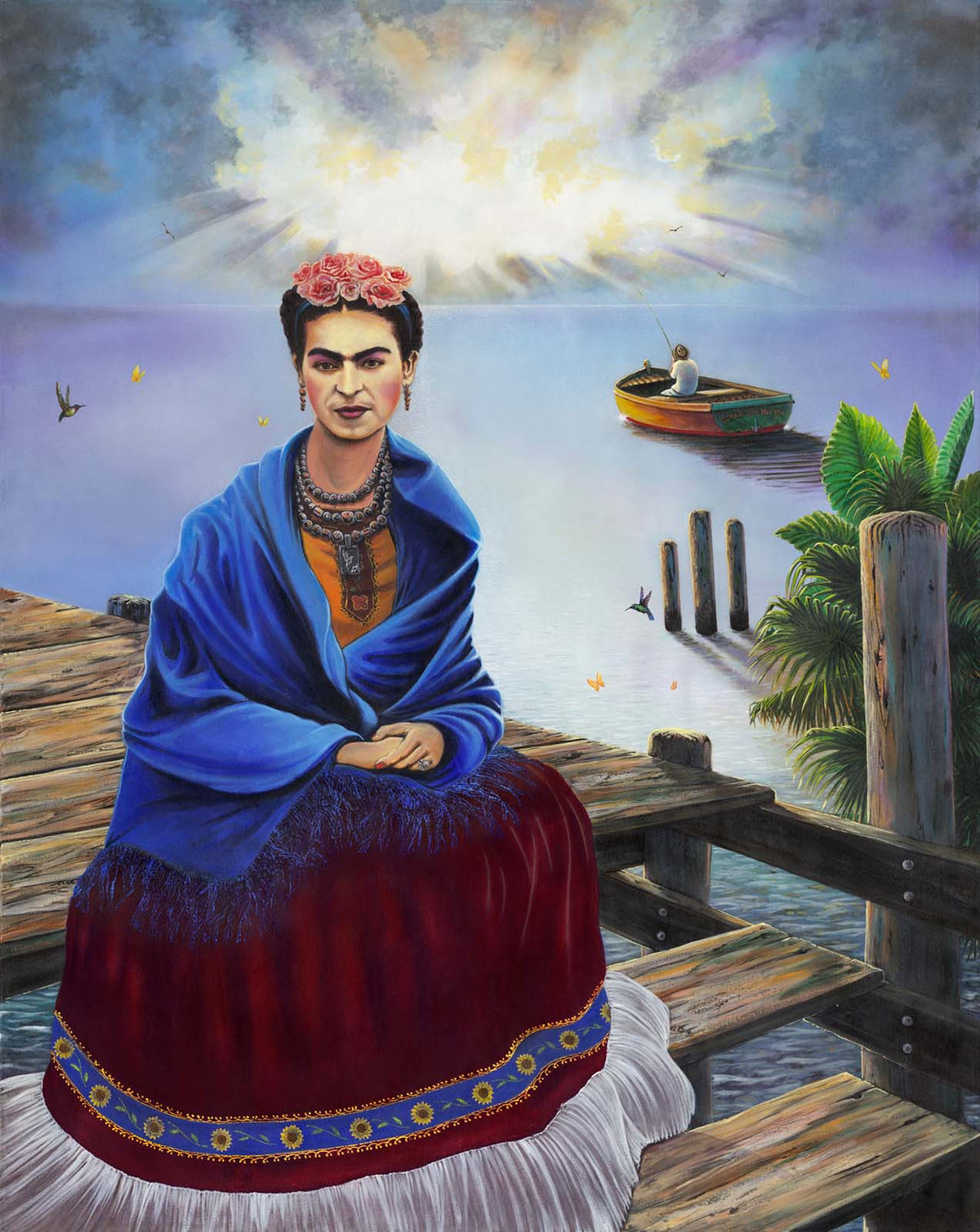
FRIDA, UN SUEÑO CARIBEÑO
In Frida, un sueño caribeño, Cuban artist Esteban Machado Díaz imagines Frida Kahlo standing on an old wooden pier, gazing toward the horizon in a moment of contemplation and possibility.
The rising light illuminates a Caribbean landscape filled with lush greens and blues, hummingbirds, and butterflies emerging from the imagination. Each new dawn becomes a symbol of hope, renewal, and the opportunity to pursue one's dreams.
Adorned with earrings and necklaces of precious stones associated with positive energy, Frida wears a hummingbird pendant that evokes the presence of a divine messenger. These symbolic elements connect her figure to the spiritual dimension of nature and the mysteries of human existence.
In the background, an islander continues his daily work aboard a small boat. His perseverance offers a quiet parallel to Frida's contemplative presence, bringing together two ways of experiencing life through determination, hope, and continuity.
Through this poetic encounter, Machado Díaz reflects on the relationship between the present and the future, suggesting that our dreams, actions, and perseverance help shape the paths that lie ahead.
Curatorial interpretation — Roselle Gallery
ESTEBAN MACHADO DÍAZ · FRIDA, A CARIBBEAN DREAM
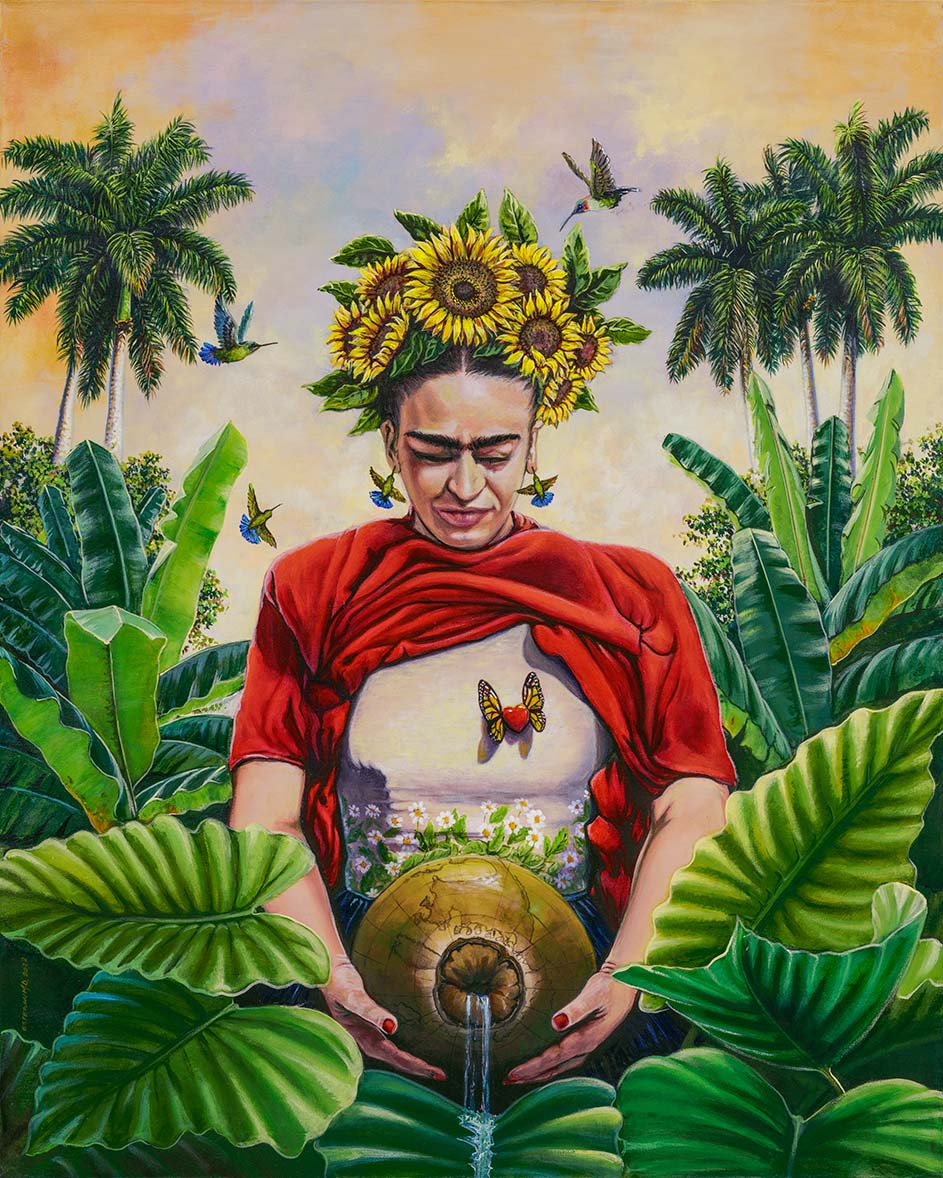
FRIDA, SURTIDOR DE TERNURA
In Frida, surtidor de ternura, Cuban artist Esteban Machado Díaz explores Frida Kahlo's extraordinary ability to transform physical suffering into artistic creation, revealing a profound relationship between vulnerability, resilience, and the enduring power of the human spirit.
After repeated struggles to recover her health, Frida found in painting a means of expressing her reality and reconstructing herself, both physically and spiritually. Through art, her pain became a source of creative expression and personal transformation.
At the center of the composition, Frida holds a coconut, a symbol deeply associated with the Caribbean. In Machado Díaz's interpretation, it becomes a representation of the world itself, pouring water to nourish the universe and evoke the continuous exchange of energy that sustains existence.
The coconut also symbolizes Frida's womb. Although she did not bear children, her creative spirit gave life to an extraordinary artistic legacy, transforming the idea of fertility into a metaphor for cultural and spiritual continuity.
Her plaster corset, a reminder of the physical suffering she endured, becomes a painted canvas adorned with white flowers symbolizing purity. Upon her chest rests a heart with monarch butterfly wings, evoking transformation, remembrance, and the annual return of the monarchs to Mexico during the season of the Day of the Dead.
Through these deeply symbolic elements, Machado Díaz portrays Frida as an enduring source of tenderness, whose spirit and artistic legacy continue to transcend suffering, time, and mortality.
Curatorial interpretation — Roselle Gallery
ESTEBAN MACHADO DÍAZ · FRIDA, A CARIBBEAN DREAM
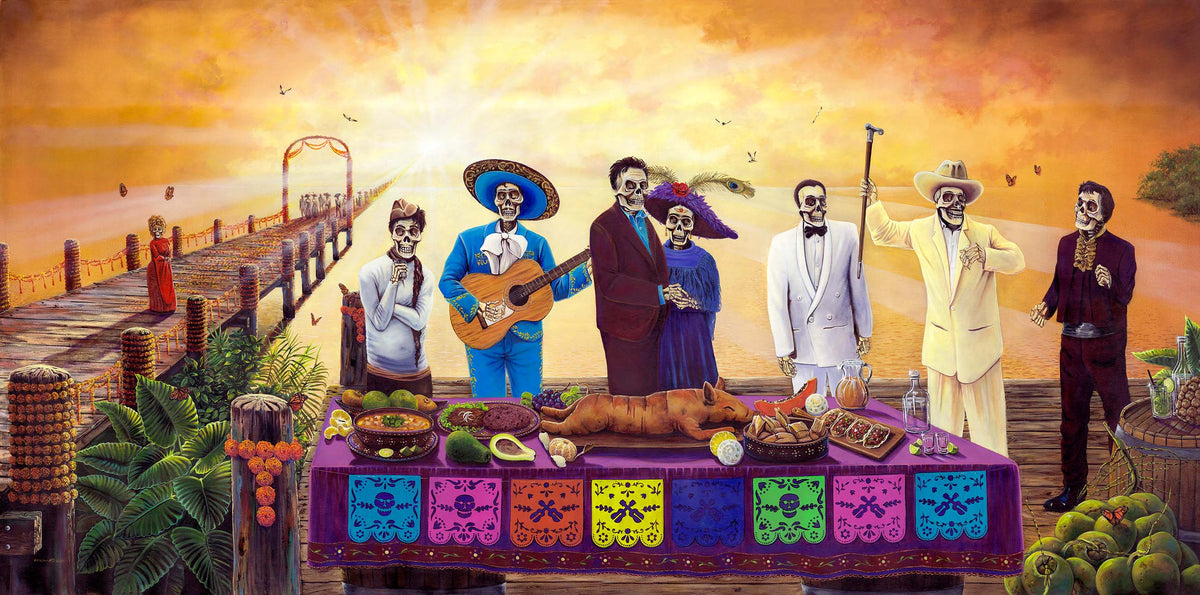
FESTIVIDAD DE LOS MUERTOS
In Festividad de los muertos, Cuban artist Esteban Machado Díaz reimagines the Mexican tradition of the Day of the Dead as a vibrant celebration of memory, cultural identity, and the enduring connections between the living and those who have passed away.
Set within an idyllic landscape, figures return from the afterlife to celebrate their special day, honoring the traces they have left in the memories of those who remember them.
Gathered around a festive table, they share food and drinks that symbolize the fusion of Mexican and Caribbean culinary traditions, where agave and sugarcane evoke the cultural richness of both regions.
The figures, recognizable through their distinctive attire and personal attributes, come together in a joyful encounter filled with music, singing, and dancing. Their celebration transforms remembrance into an expression of life, affection, and cultural continuity.
Through this imaginative gathering, Machado Díaz presents the Day of the Dead not as a farewell, but as a symbolic reunion in which memory keeps human relationships alive beyond the boundaries of time and mortality.
Curatorial interpretation — Roselle Gallery
ESTEBAN MACHADO DÍAZ · FRIDA, A CARIBBEAN DREAM
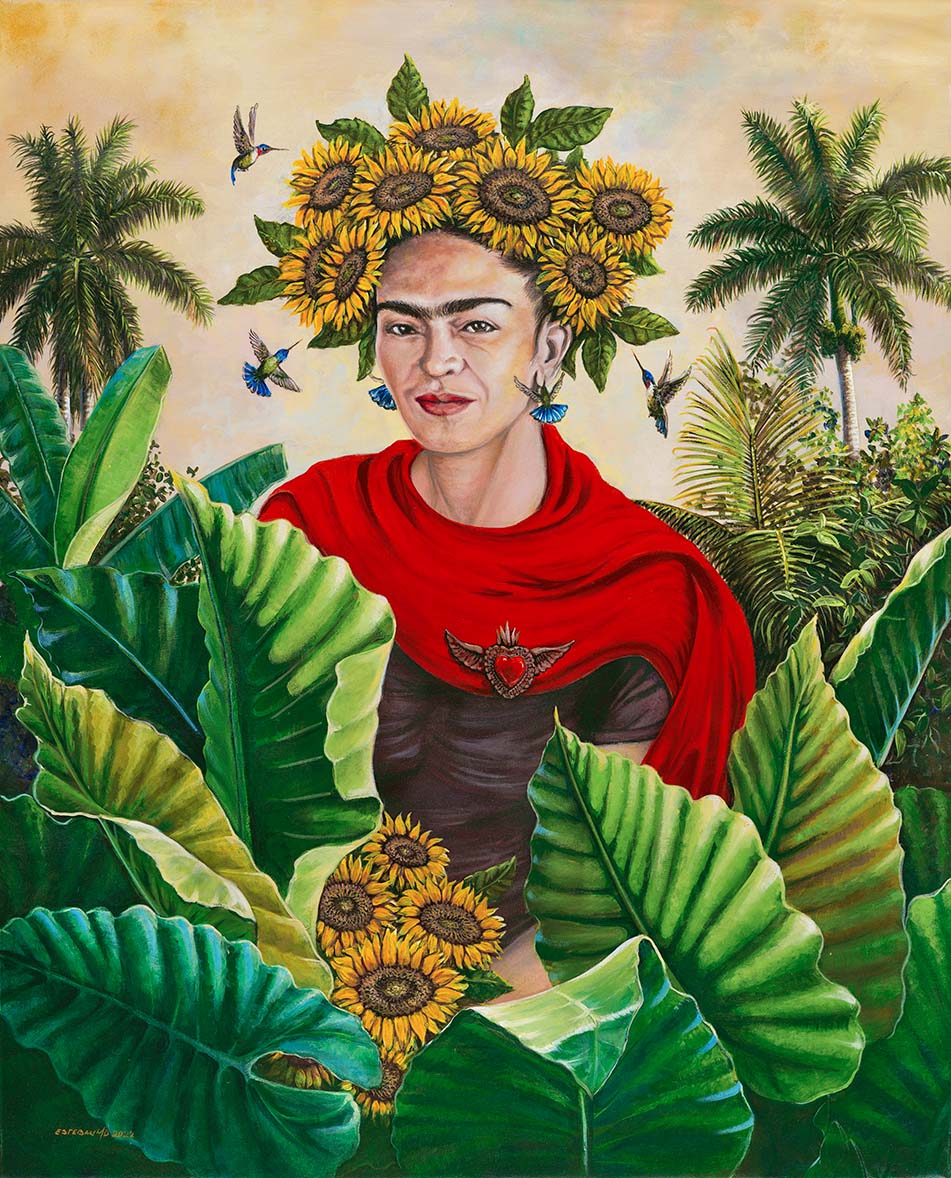
FRIDA CARIBEÑA
In Frida Caribeña, Cuban artist Esteban Machado Díaz envisions Frida Kahlo as a symbolic presence connecting two cultures whose histories and identities have long been intertwined: Mexico and Cuba.
Frida emerges within a vibrant Caribbean landscape, crowned with sunflowers that evoke the spiritual presence of Our Lady of Charity, the patron saint of Cuba. Around her, hummingbirds dance and whisper like divine messengers, establishing a connection between the natural world and the realm of spirituality.
Nature becomes a celebration of life itself, representing both the origins of human existence and the forces that sustain it. In contrast, Frida's red mantle expresses her passionate relationship with life, recalling the emotional intensity that shaped her personal and artistic journey.
A heart-shaped brooch symbolizes her strength, determination, and inner resilience. It becomes an expression of the spiritual energy that sustained her throughout a life marked by extraordinary passion and profound suffering.
Through this fusion of cultural and spiritual symbols, Machado Díaz presents a Frida who transcends geographical boundaries and historical time, transforming her image into a celebration of shared heritage, human perseverance, and the enduring power of art.
Curatorial interpretation — Roselle Gallery
ESTEBAN MACHADO DÍAZ · FRIDA, A CARIBBEAN DREAM
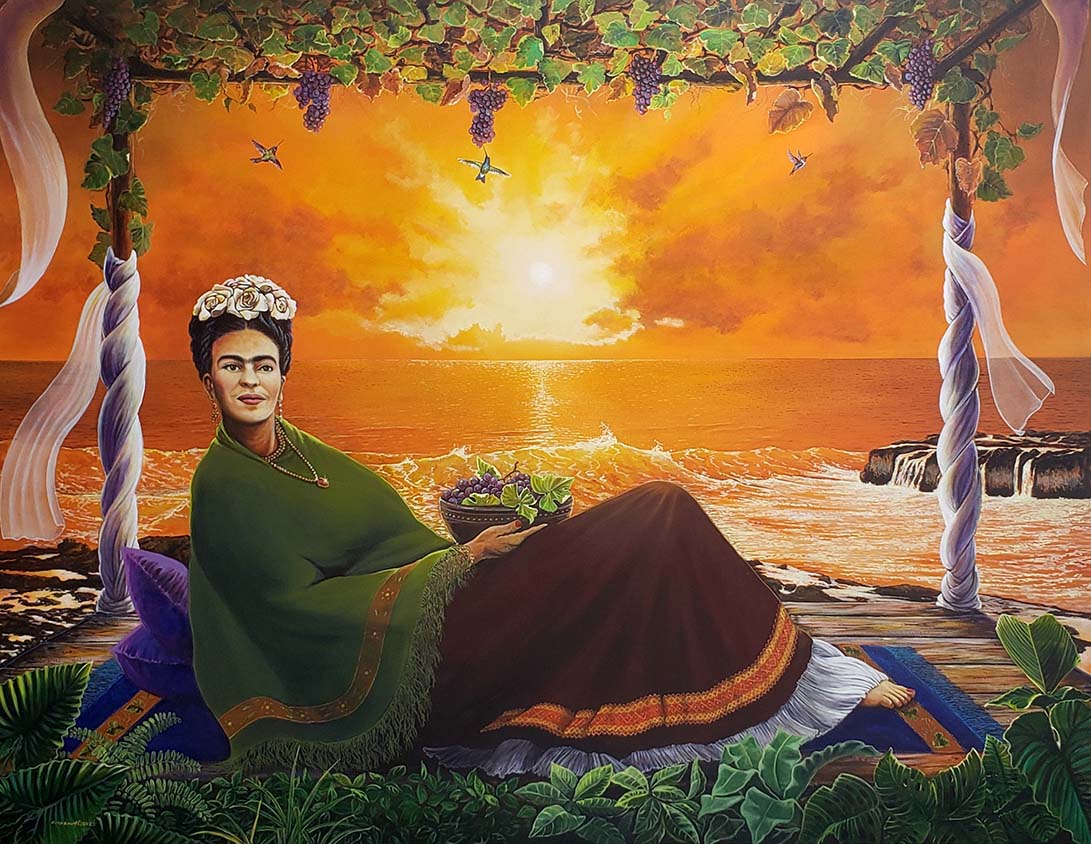
FRIDA ENTRE LO TERRENAL Y LO DIVINO
In Frida entre lo terrenal y lo divino, Cuban artist Esteban Machado Díaz presents Frida Kahlo in the reclining position of a Chac Mool, a sculptural figure associated with ancient Mesoamerican cultures, including the Maya and Toltec traditions.
In the artist's interpretation, the Chac Mool evokes a guardian of the underworld, a traveler through time, or a messenger of the gods. Such figures are often represented with a receptacle resting upon the abdomen, traditionally associated with offerings.
Against this symbolic background, Machado Díaz places Frida within a Caribbean coastal landscape at sunset, where the sea washes against the rocks. The natural setting creates an atmosphere of contemplation, connecting the physical world with the mysteries of spiritual existence.
Frida rests beneath a pergola crowned with grapevines and clusters of grapes, from which hummingbirds drink. These birds, recurring symbols throughout the artist's collection, appear as divine messengers linking nature and spirituality.
The pergola becomes the central metaphor of the composition: a threshold between the earthly and the divine. Through this encounter between ancestral symbolism, Caribbean nature, and the figure of Frida Kahlo, Machado Díaz invites viewers to contemplate the relationship between human existence and the spiritual realm.
Curatorial interpretation — Roselle Gallery
ESTEBAN MACHADO DÍAZ · FRIDA, A CARIBBEAN DREAM
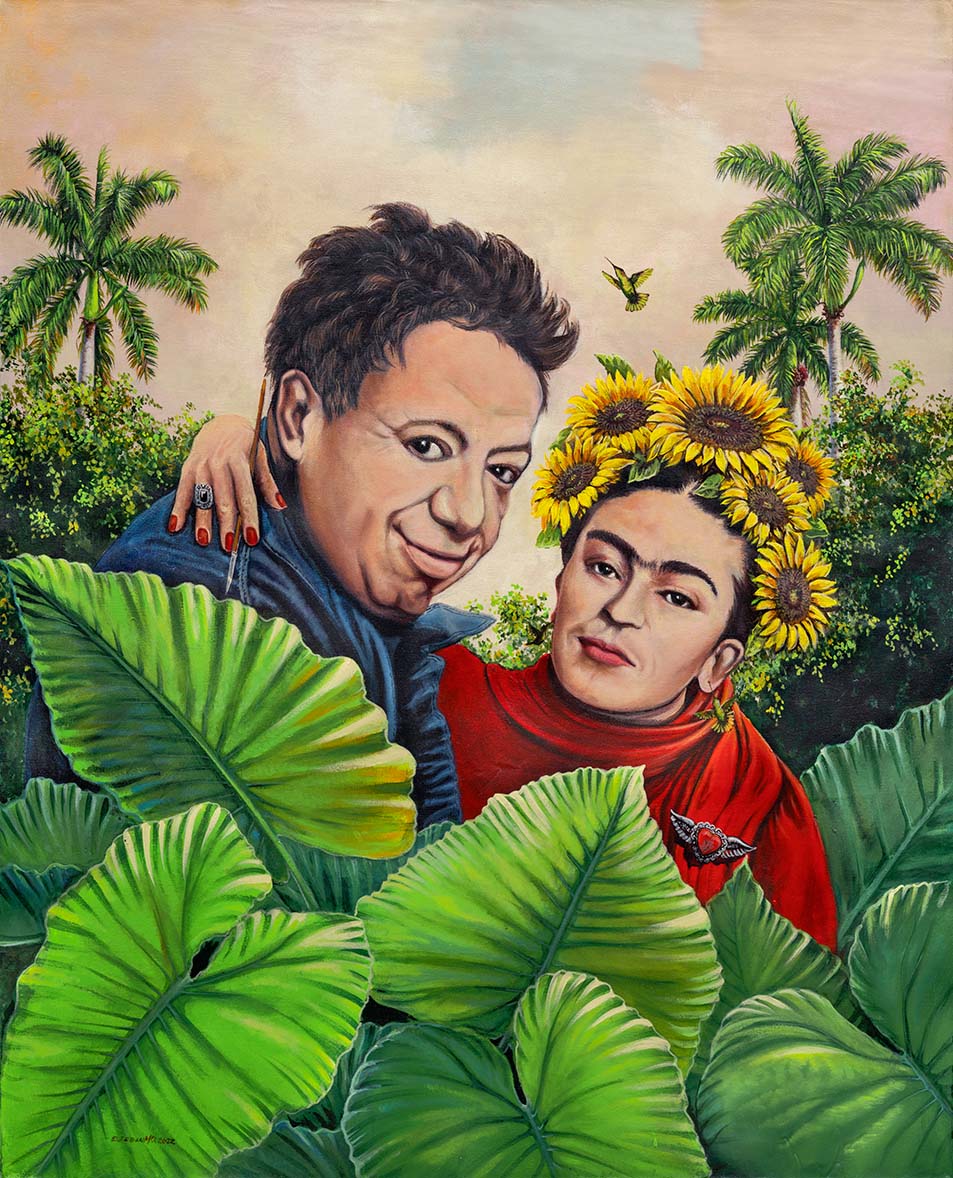
LAS PASIONES DE FRIDA
In Las pasiones de Frida, Cuban artist Esteban Machado Díaz explores the emotional intensity of Frida Kahlo's life, reflecting on love, suffering, artistic creation, and the determination of a woman who refused to surrender her identity.
At the heart of this interpretation lies Frida's complex relationship with Diego Rivera, the celebrated Mexican muralist. Their love was marked by passion, conflict, infidelity, separation, and reconciliation, creating a bond that remained deeply significant throughout their lives.
Machado Díaz approaches this relationship as an expression of the contradictions of human love. Tenderness and rebellion, devotion and disappointment coexist in a story shaped by powerful emotions and an enduring connection.
Yet Frida's passions extended far beyond her relationship with Diego. In her right hand, she holds a paintbrush, symbolizing another defining force in her existence: art. Through painting, she transformed personal suffering into creative expression and established a legacy that continues to resonate across generations.
A Mexican silver ring adorned with an onyx stone introduces a spiritual dimension to the composition. In the artist's symbolism, the stone represents the cleansing and balancing of personal energy, evoking Frida's search for emotional and spiritual equilibrium.
Through these elements, Las pasiones de Frida celebrates a woman who experienced love and pain with extraordinary intensity, defended her individuality, and ultimately transcended the circumstances of her life through the enduring power of artistic creation.
Curatorial interpretation — Roselle Gallery
ESTEBAN MACHADO DÍAZ · FRIDA, A CARIBBEAN DREAM
MI SUEÑO DULCE Y PROFUNDO
In Mi sueño dulce y profundo, Cuban artist Esteban Machado Díaz brings together the spiritual legacy of Frida Kahlo and the poetic vision of José Martí in a reflection on love, suffering, dreams, and the enduring power of the human spirit.
The painting draws inspiration from a verse by Martí, in which sleep, nature, and the human body become part of a poetic meditation on existence. This literary encounter provides the foundation for Machado Díaz's interpretation of Frida as a figure whose spirit continues to grow beyond the boundaries of her earthly life.
Through the symbolic fusion of pain and dreams, the artist explores the capacity of human beings to transform suffering into spiritual growth. Frida emerges as an expression of tenderness, determination, and the strength of a heart guided by love.
The dialogue between Martí and Frida also reflects the cultural connections between Cuba and Mexico. Although their lives belong to different historical contexts, Machado Díaz brings their legacies together through shared ideas of humanity, emotional depth, and the enduring significance of cultural identity.
More than a tribute to two extraordinary figures, Mi sueño dulce y profundo becomes a meditation on the roots that connect peoples and the spiritual inheritance that art and poetry preserve across generations.
Curatorial interpretation — Roselle Gallery
ESTEBAN MACHADO DÍAZ · FRIDA, A CARIBBEAN DREAM
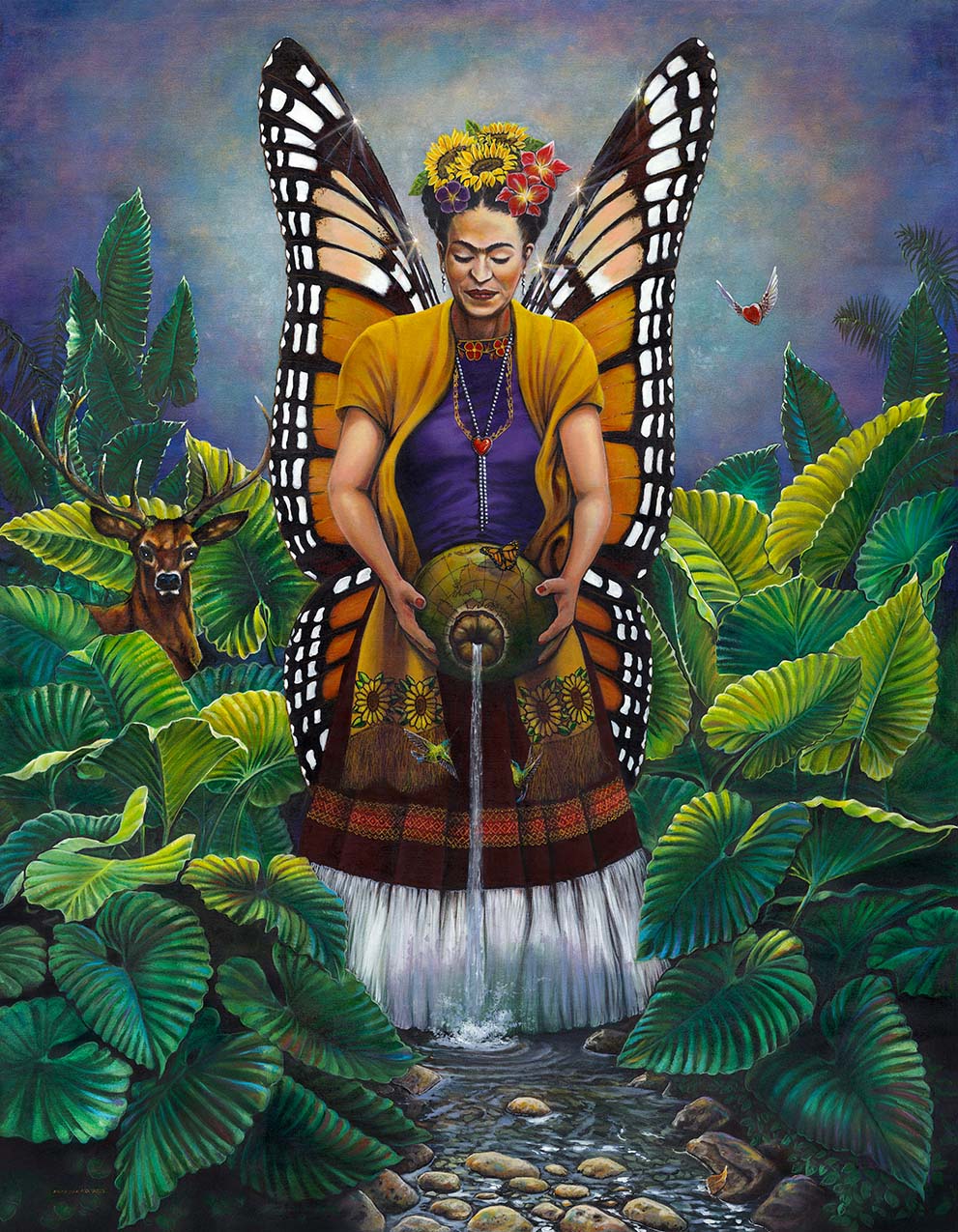
ODA A FRIDA
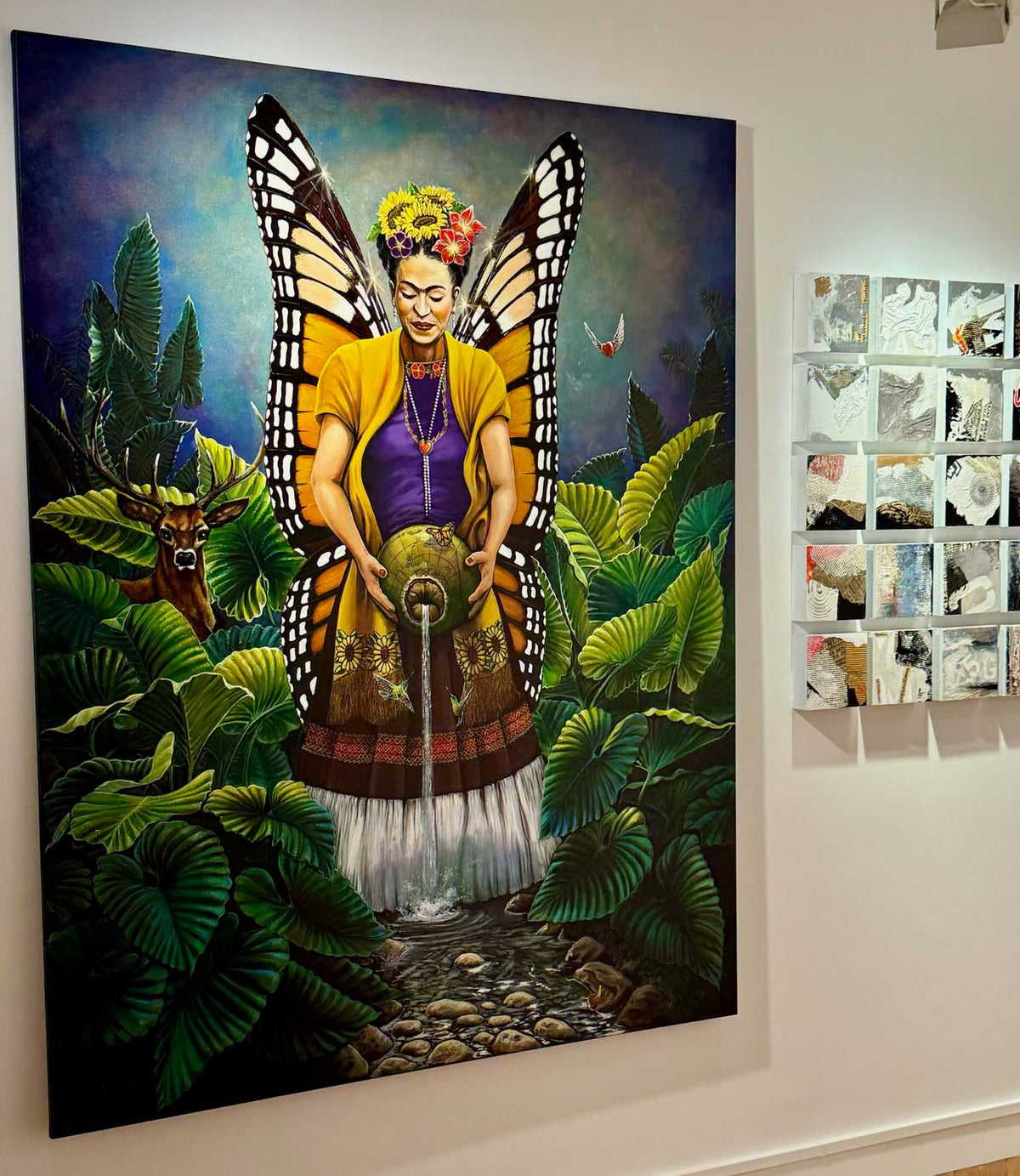
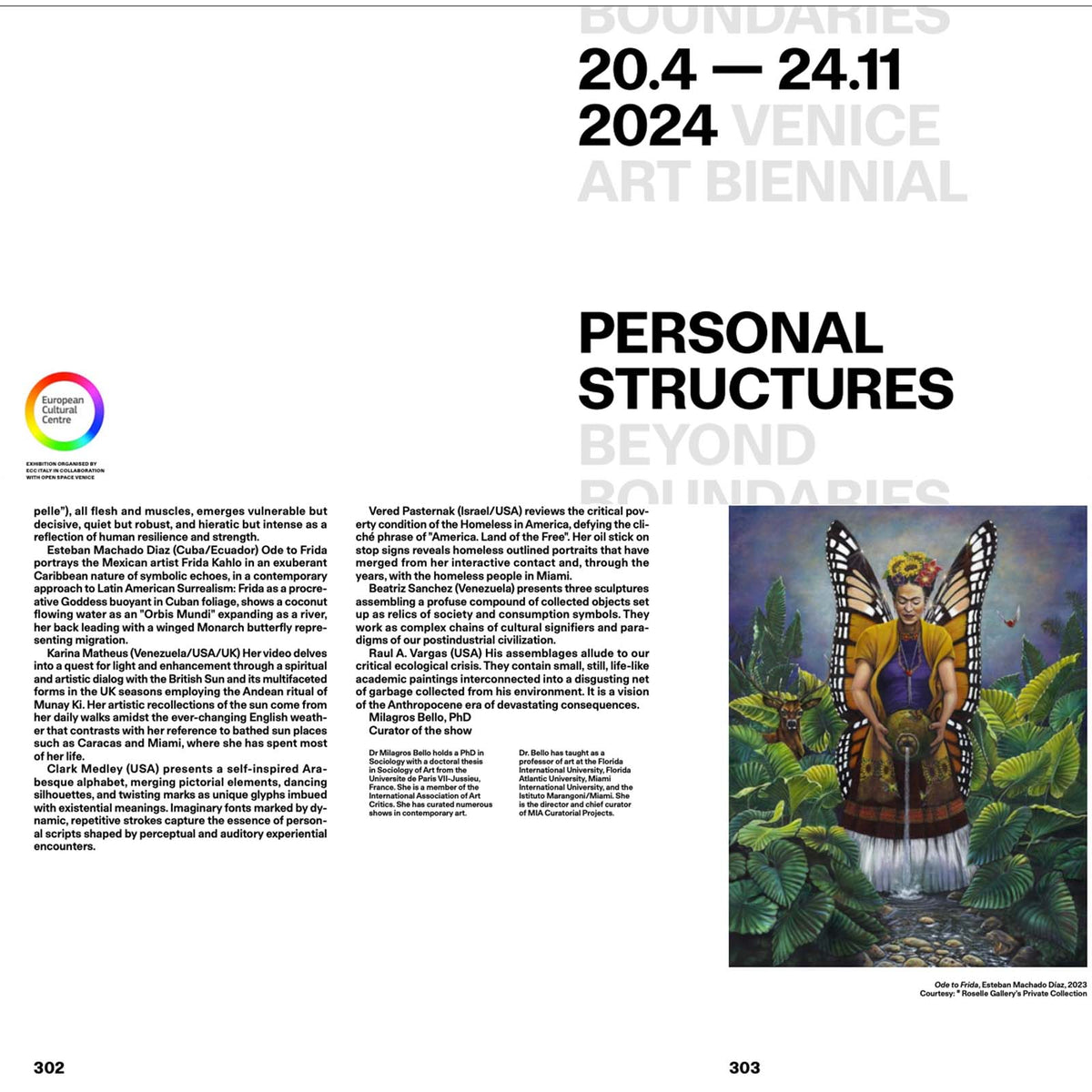
In Oda a Frida, Cuban artist Esteban Machado Díaz brings together the essential themes of his artistic tribute to Frida Kahlo, creating a synthesis of cultural identity, poetic inspiration, spiritual resilience, and the enduring dialogue between Mexico and Cuba.
At the heart of the composition lies a remarkable encounter between the poetry of José Martí and Frida Kahlo's visual language. Machado Díaz draws inspiration from Martí's verses describing a wounded deer seeking refuge in the mountains, establishing a poetic connection with Frida's celebrated painting The Wounded Deer, in which she portrays herself through the body of a deer pierced by arrows.
For Machado Díaz, this parallel becomes a symbolic meeting between two creative legacies shaped by suffering, artistic expression, and the search for transcendence. Rather than illustrating either artist, he brings their imagery into a new visual dialogue rooted in his own Caribbean identity.
The composition introduces a fountain as a reference to Martí's poetic universe, transforming it into a source of tenderness, passion, and spiritual renewal. Frida appears once again with wings, suggesting the possibility of rising beyond pain and reaching a universal dimension through the enduring power of art.
Surrounded by Caribbean nature, Frida becomes part of a landscape that Machado Díaz embraces as his own. Through this symbolic encounter, the artist honors her ability to inspire self-acceptance, fidelity to one's roots, and the courage to embrace human vulnerability.
Oda a Frida ultimately stands as a tribute to the cultural and spiritual legacies that have shaped the artist's creative vision. It is both a celebration of Frida Kahlo and an expression of the profound connections between poetry, painting, memory, and identity.
Curatorial interpretation — Roselle Gallery
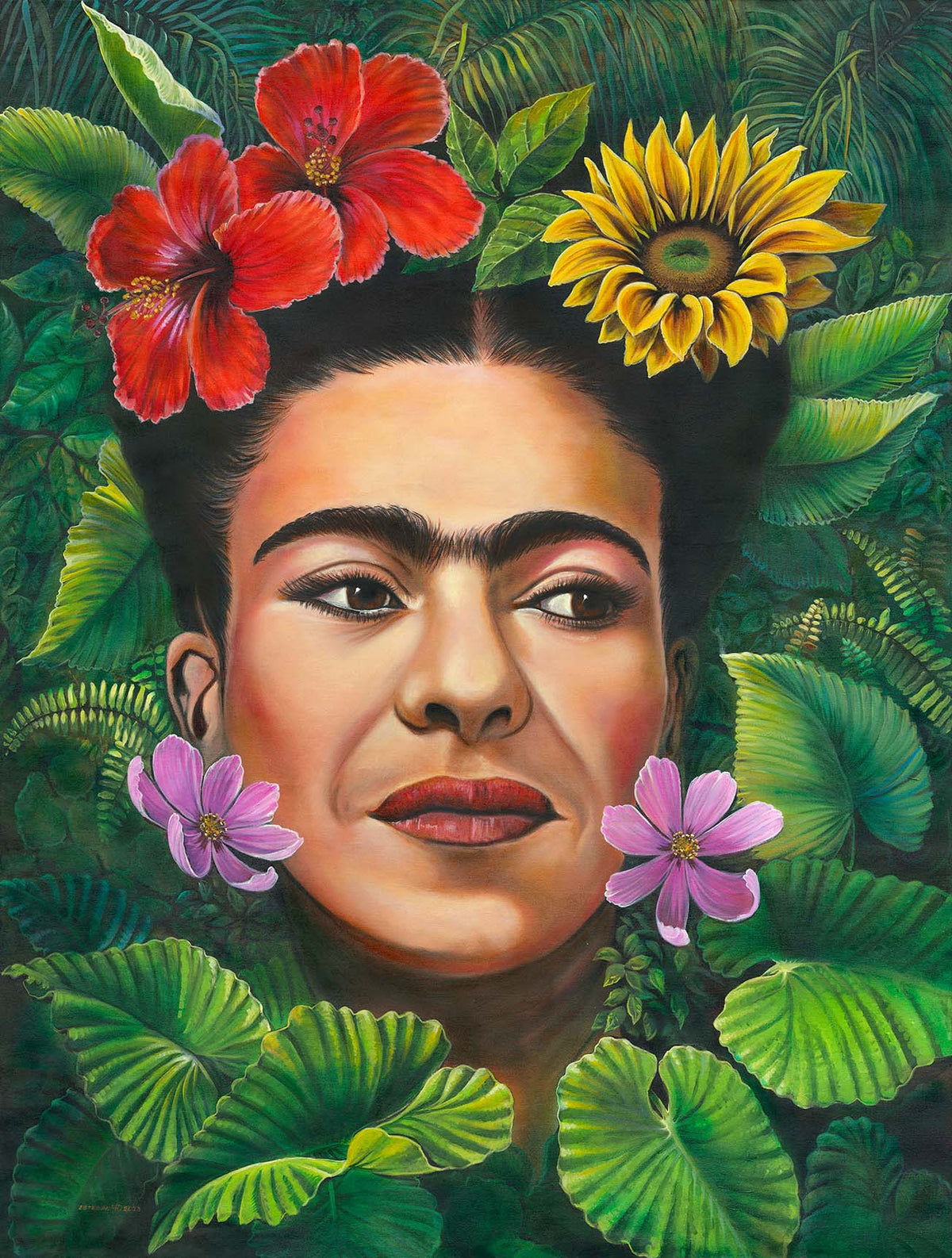
ESTEBAN MACHADO DÍAZ · A CONTINUING TRIBUTE TO FRIDA KAHLO
EMPODERADA
Empoderada emerged from a remarkable encounter in Mexico City on October 28, 2022, just one day after the inauguration of Frida, un sueño caribeño, Esteban Machado Díaz's artistic tribute to Frida Kahlo.
On that occasion, the Cuban artist was welcomed into the private home museum of an extraordinary woman, deeply devoted to Frida's life, artistic legacy, and the preservation of her memory. A passionate collector and advocate for the recognition of Frida's cultural significance, she embodied values of dignity, commitment, and respect that profoundly resonated with Machado Díaz.
During a memorable lunch shared with individuals united by their appreciation for culture and heritage, the artist spontaneously sketched an idea on a cloth napkin. That intimate creative gesture became the starting point for Empoderada.
The painting preserves the emotional significance of that encounter, bringing together two women through a symbolic dialogue between history and the present, artistic legacy and personal commitment.
Out of loyalty, admiration, and respect, Machado Díaz has chosen not to disclose the identity of the woman who inspired this tribute alongside Frida Kahlo. Her anonymity remains an intentional and meaningful part of the artwork's story.
Beyond its personal origins, Empoderada is also a tribute to women across generations who have shaped history through love, courage, perseverance, and an unwavering commitment to their convictions.
Through this work, Machado Díaz extends his artistic homage to Frida beyond the original exhibition, celebrating women's strength and their enduring contributions to culture, memory, and human experience.
Curatorial interpretation — Roselle Gallery
MEXICO CITY · OCTOBER 27, 2022
THE INAUGURAL EXHIBITION


THE BEGINNING · MEXICO CITY
2022
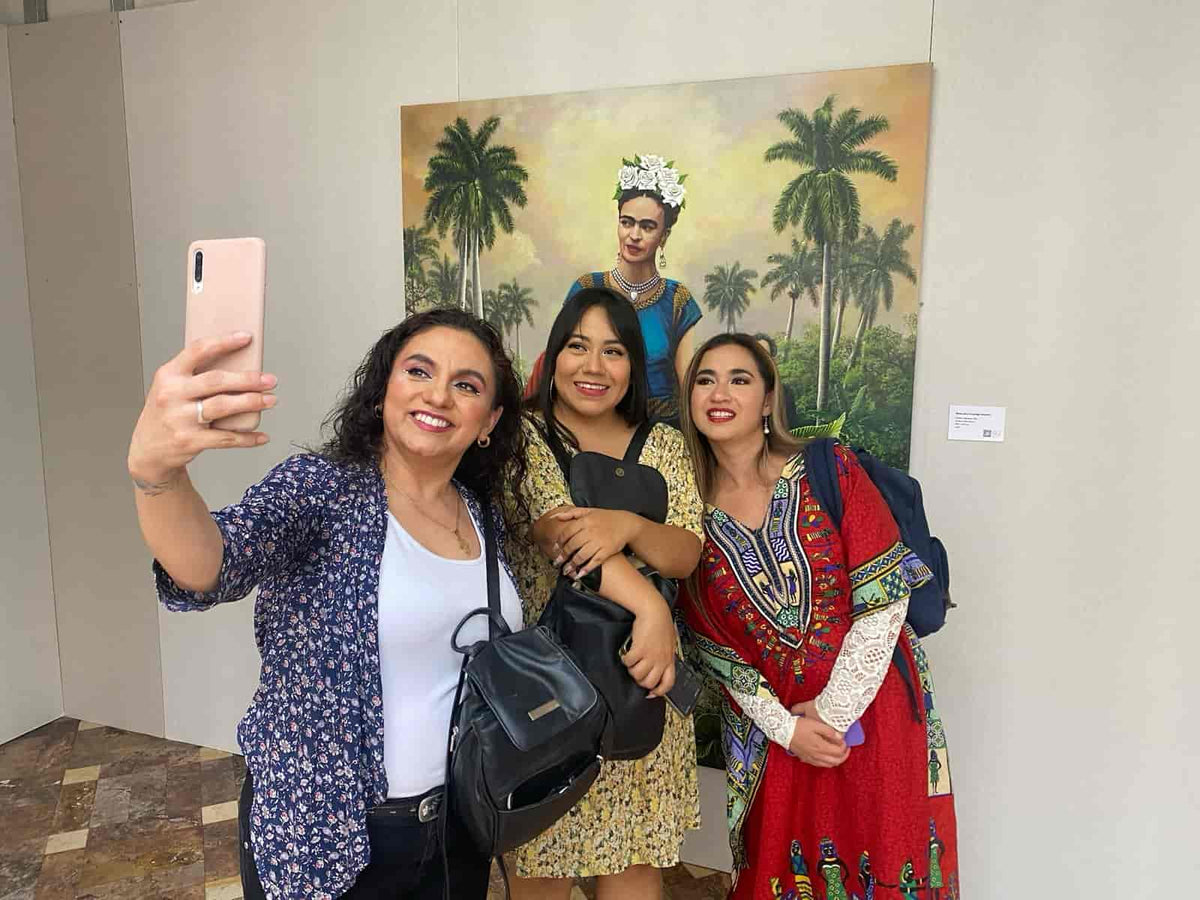
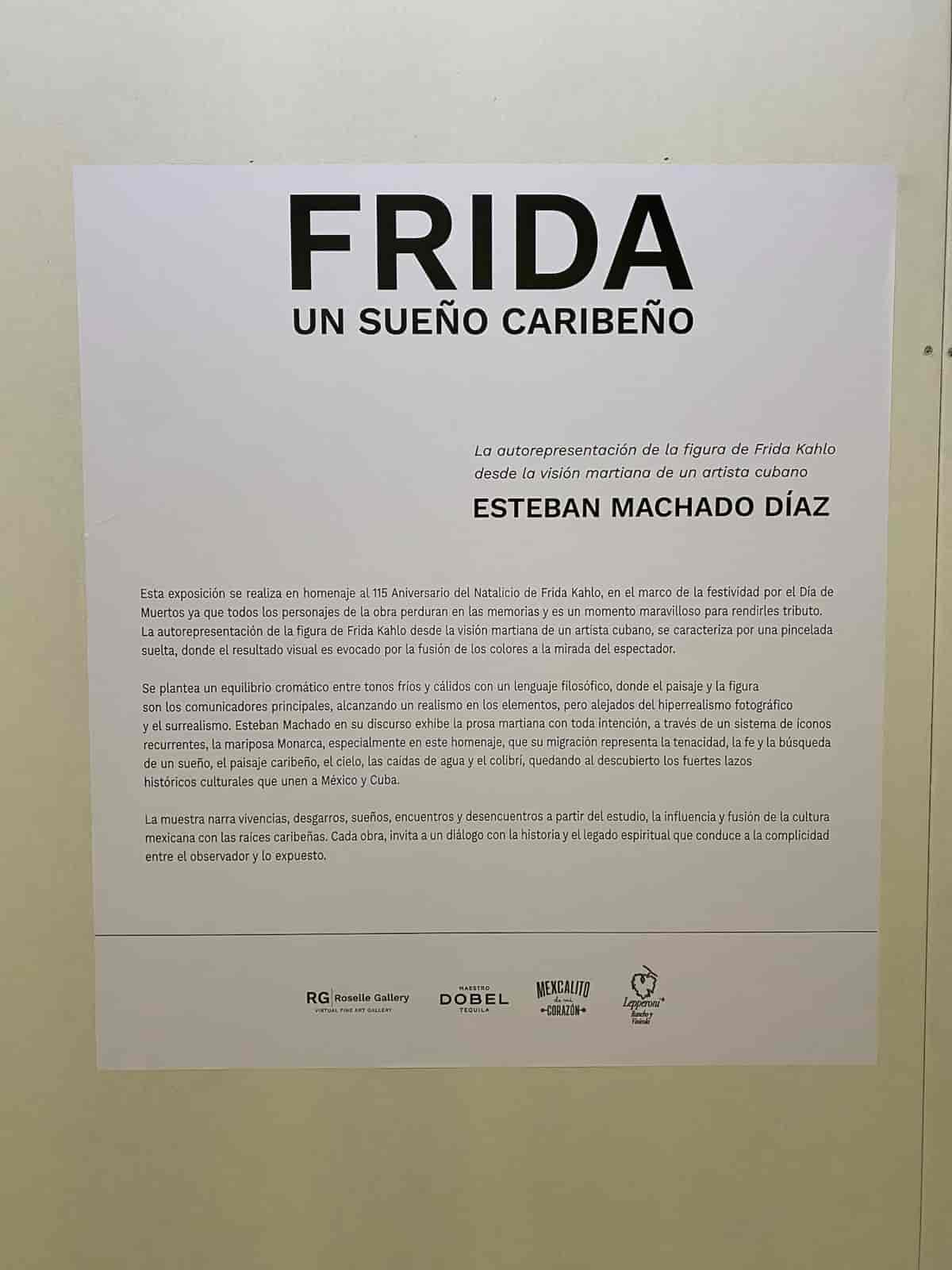
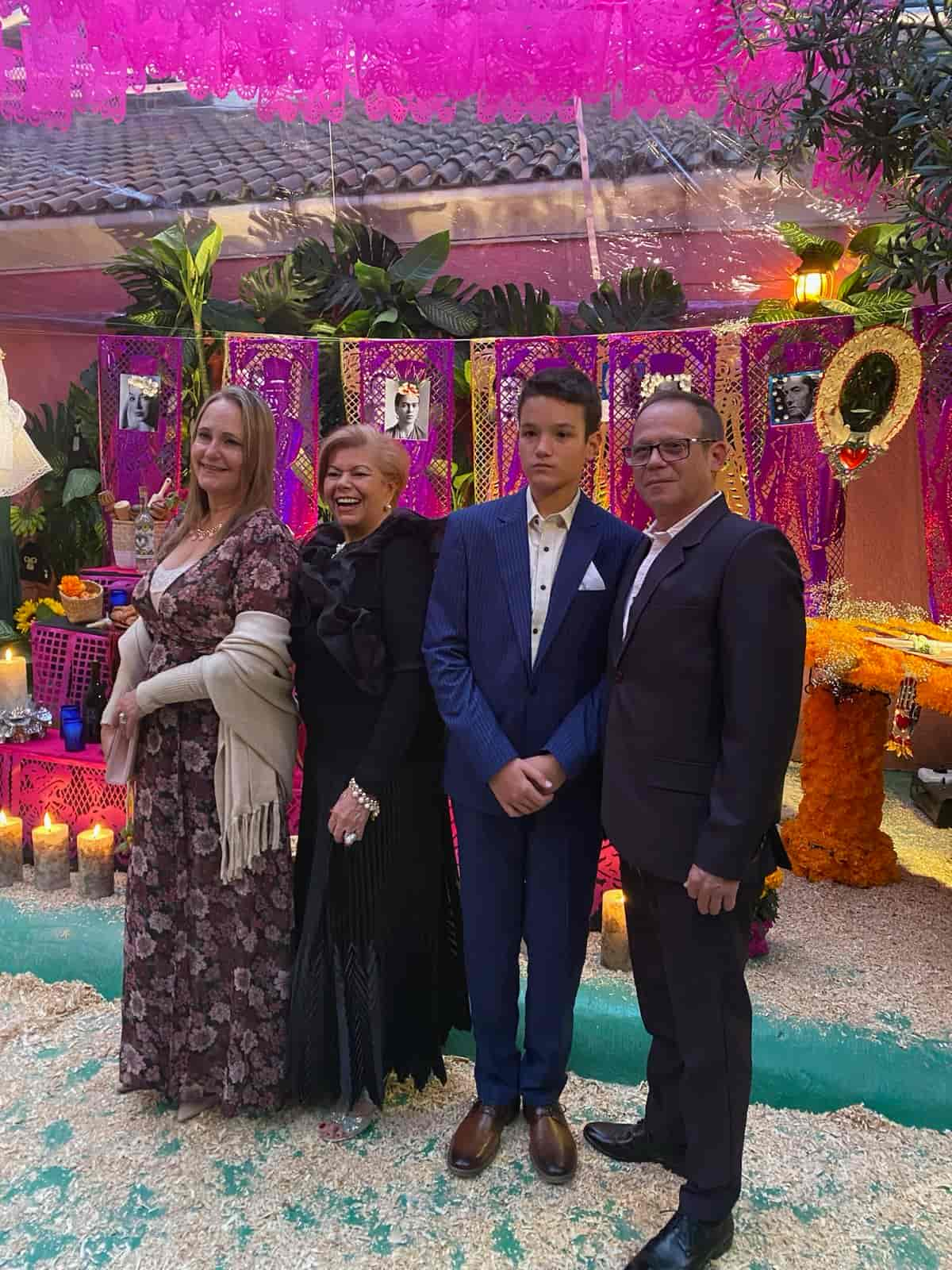
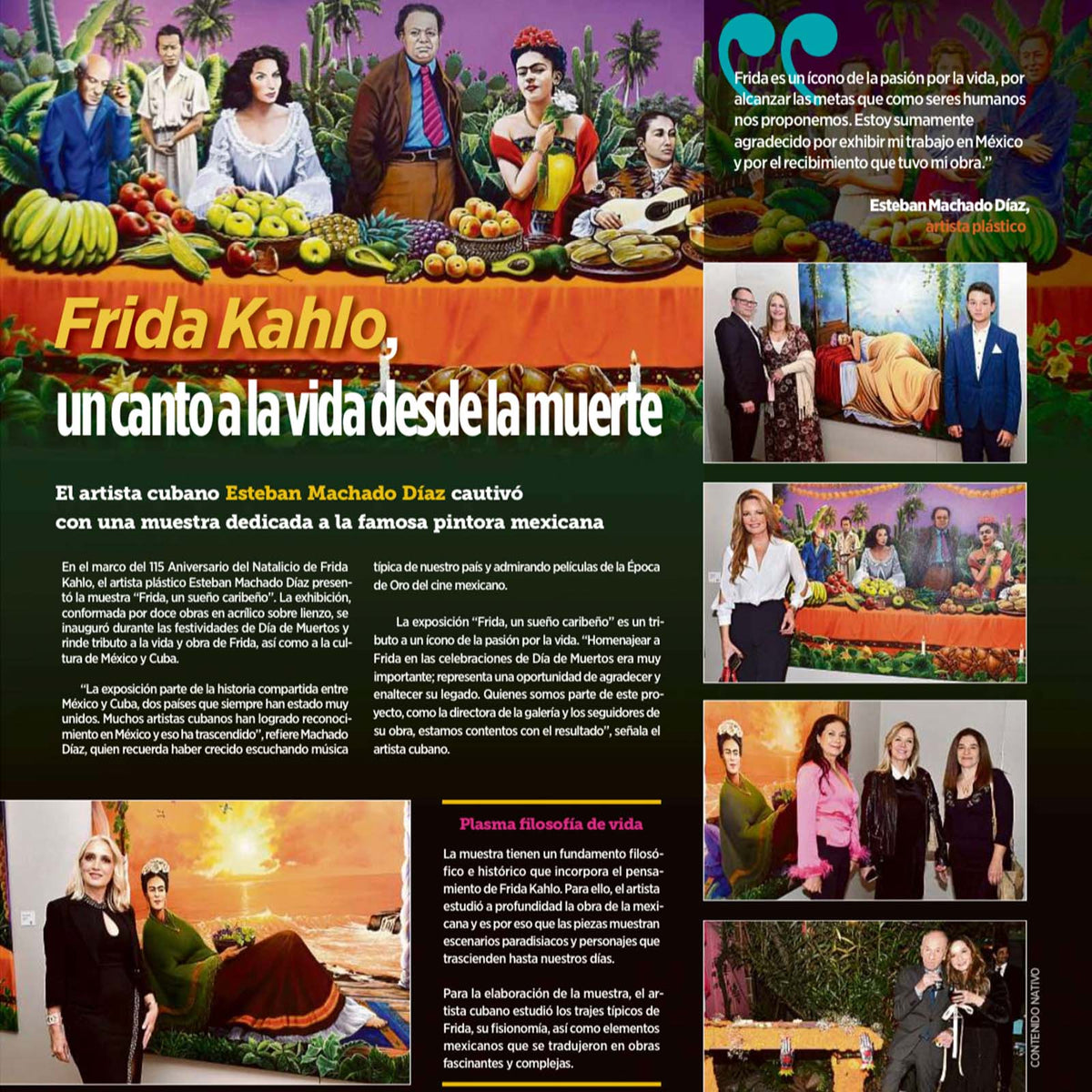
On October 27, 2022, Roselle Gallery inaugurated Frida, un sueño caribeño (Frida, a Caribbean Dream) by Cuban artist Esteban Machado Díaz at Casa León in Mexico City.
Inspired by Frida Kahlo, the exhibition brought Mexican and Caribbean cultural identities into dialogue, marking the beginning of Roselle Gallery's artistic journey.
CULTURAL CONNECTIONS · MIAMI
2023
In 2023, Frida, a Caribbean Dream continued its cultural journey in South Florida, connecting Mexican and Caribbean artistic traditions.
Through Hispanic Heritage Month activities in Miramar, a tribute to Frida Kahlo at the Mexican Cultural Institute in Miami, and Roselle Gallery's participation in Aqua Art Miami, the project expanded its presence and reached new audiences.
VENICE, ITALY · PALAZZO BEMBO
2024
In 2024, Oda a Frida by Esteban Machado Díaz was exhibited for more than three months at Palazzo Bembo in Venice, Italy, as part of Personal Structures, an international contemporary art exhibition organized by the European Cultural Centre.
Inspired by José Martí's poetry and Frida Kahlo's symbolic universe, the painting brought the artist's Caribbean interpretation of Frida to an international audience. Its inclusion in the official exhibition catalogue further documented this milestone.
FRIDA KAHLO · ART & CULTURAL DIALOGUE
2025
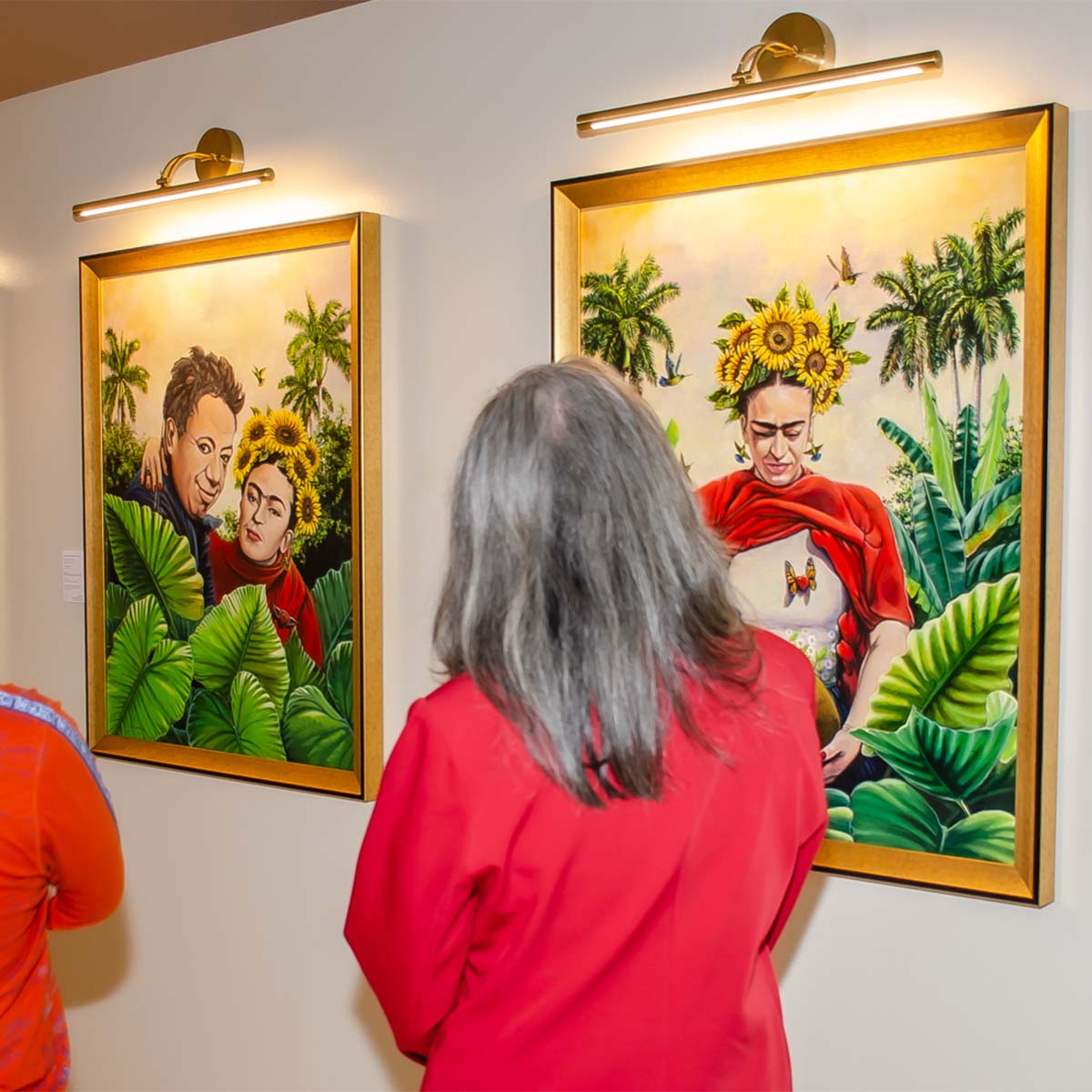
On November 15, 2025, Roselle Gallery continued its artistic tribute to Frida Kahlo through Viva La Vida: Frida Kahlo, an event combining an insightful lecture with an opportunity to experience works by Esteban Machado Díaz.
The encounter invited audiences to explore Frida's enduring cultural legacy and the dialogue between Mexican and Caribbean artistic traditions.
FRIDA MYSTICISM · MIAMI
2026
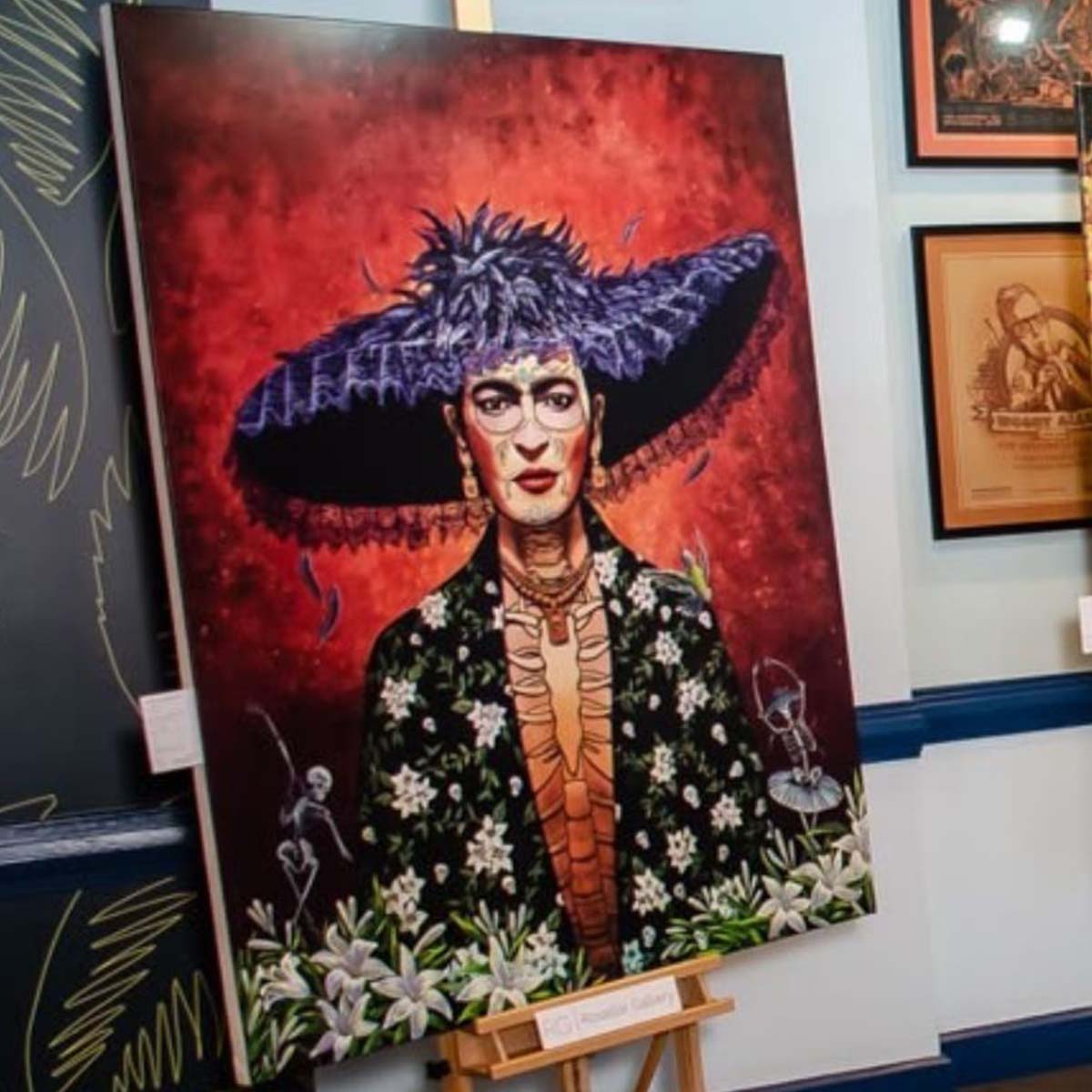
In August 2026, Roselle Gallery presented Frida Mysticism as part of the Art Exhibitions Program of the 31st International Ballet Festival of Miami.
Featuring three artist-intervened reproductions from Esteban Machado Díaz's Frida, a Caribbean Dream collection, the presentation brought visual art and ballet into dialogue, celebrating Frida Kahlo's enduring legacy through painting, movement, and cultural expression.
PRESS · PUBLICATIONS · ARCHIVES
A STORY DOCUMENTED
From its inaugural exhibition in Mexico City to its international presentations, Frida, a Caribbean Dream has built a documentary legacy through exhibition catalogues, editorial publications, and cultural archives.
These materials preserve significant moments in Esteban Machado Díaz's artistic tribute to Frida Kahlo and trace the evolving international journey of the collection.
ART · MEMORY · CULTURAL DIALOGUE
THE LEGACY OF A CARIBBEAN DREAM
What began in Mexico City in October 2022 as an artistic tribute to Frida Kahlo has evolved into an enduring dialogue between cultures, memories, and artistic traditions.
Through Frida, a Caribbean Dream, Cuban artist Esteban Machado Díaz reimagines Frida's legacy through the visual language of the Caribbean, bringing together symbolism, spirituality, nature, and the shared cultural heritage of Mexico and Cuba.
The collection extends beyond portraiture. It explores the resilience of the human spirit, the transformative power of imagination, and the enduring relationship between art and identity.
As the works continue their journey through exhibitions and cultural encounters, they carry forward the vision that inspired Roselle Gallery's inaugural exhibition: to create meaningful connections between Latin American artistic expression and audiences across borders.
Four years later, Frida, a Caribbean Dream remains both a tribute to an extraordinary artist and a testament to the power of art to transcend time, geography, and generations.
FOUR YEARS OF ART, CULTURE & CONNECTION
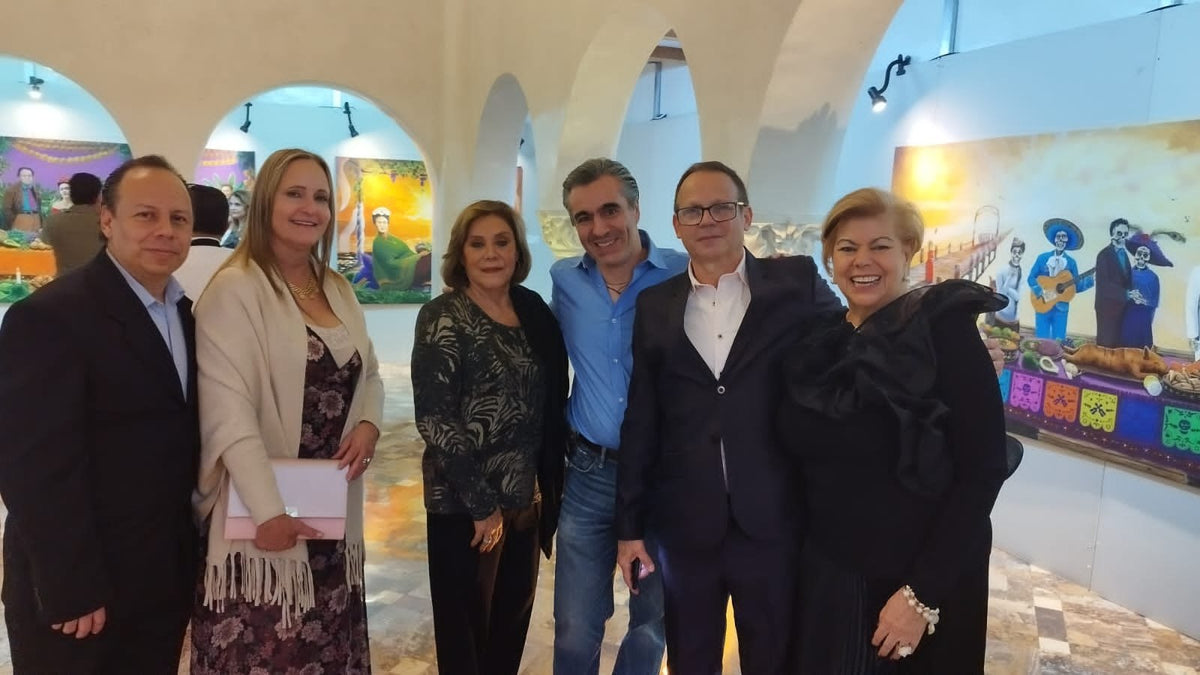
On October 27, 2022, Roselle Gallery opened its doors to a journey of art and cultural discovery with Frida, a Caribbean Dream, an exhibition by Cuban artist Esteban Machado Díaz in Mexico City.
Four years later, we celebrate that beginning with gratitude to the artists, collectors, institutions, collaborators, and audiences who have become part of our story.
What began as a dream continues as a commitment to sharing contemporary Latin American art with the world.
Roselle Gallery — Four Years of Art, Culture & Connection
October 27, 2022 – October 27, 2026

Manténgase actualizado
Suscríbete a nuestro boletín para mantenerte informado sobre tus artistas favoritos, nuevas exposiciones y eventos.